
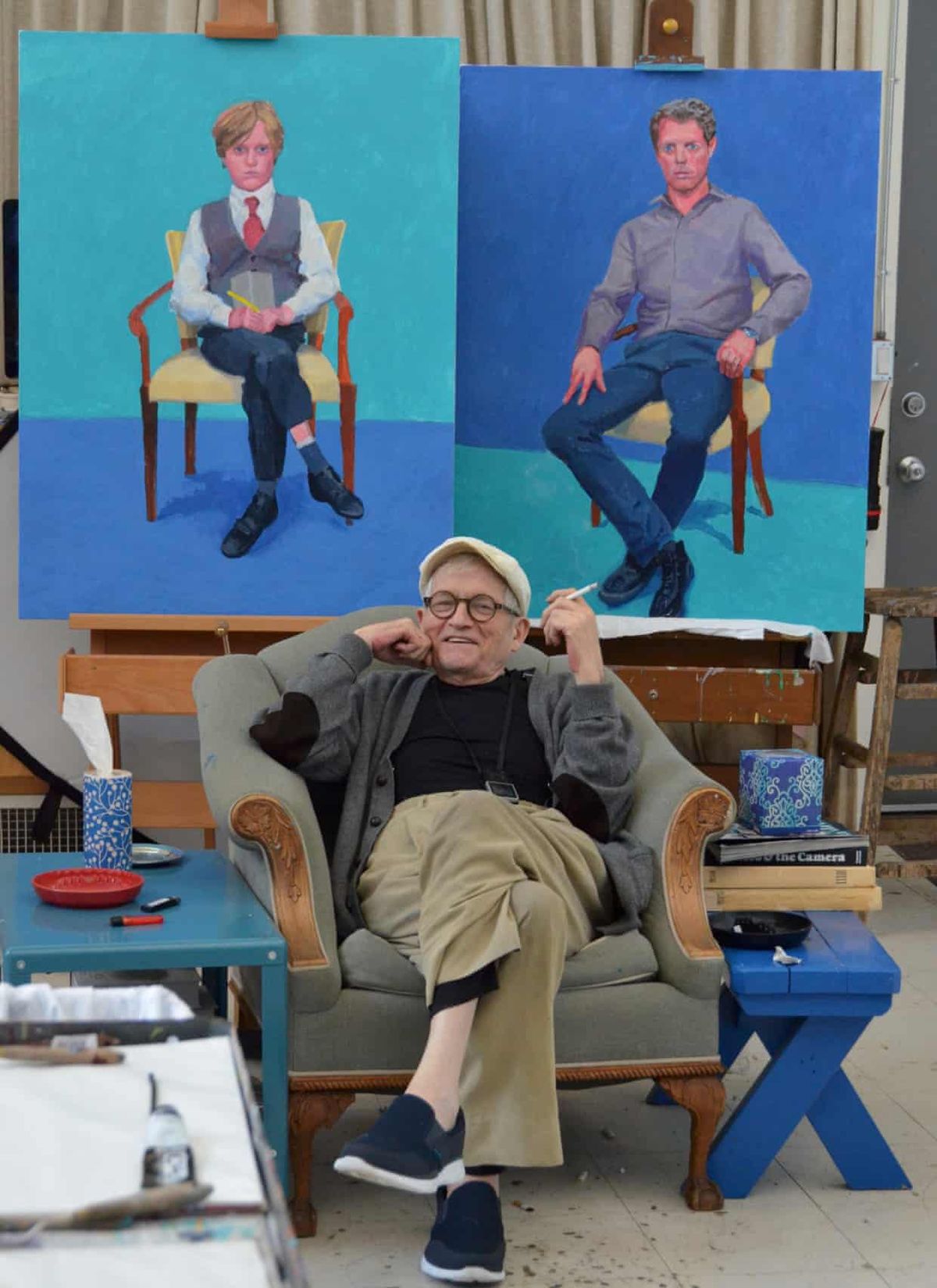
David Hockney’s self portraits document his life over six decades, showing how his style, tools, and appearance changed with time. Created across painting, printmaking, photography, and digital media, they explore identity, vision, and aging through repeated, evolving self-representation.
Over a career spanning more than six decades, David Hockney has produced an extraordinary number of self portraits across painting, printmaking, photography, and digital media. Despite this, his self portraits are often misunderstood and viewed mainly as stylistic experiments rather than as a sustained examination of identity. What does it mean to depict oneself repeatedly as time passes and artistic tools evolve? This article examines Hockney’s self portraits as a lifelong inquiry, revealing how they reflect aging, perception, and continual artistic reinvention.
Self-Portraiture as a Method, Not a Genre

Image source: pinterest.com
For Hockney, the self-portrait is not a fixed genre but a working method. Throughout his career, he has treated his own image as a convenient and endlessly available subject—one that allows him to test ideas about colour, line, space, and perception without the complications of commissioning or arranging a sitter.
This practical motivation quickly expanded into something more profound. Over time, Hockney’s self-portraits became sites of philosophical inquiry, asking how vision operates, how technology mediates experience, and how identity changes across decades. The repetition of his own face allows viewers to track not only physical aging, but shifts in artistic thinking.
Britain’s visual arts culture exists alongside a strong performance tradition, with galleries, museums, and Theatres Manchester shaping the country’s wider creative landscape.
Early Self-Portraits: Formation and Psychological Inquiry (1950s–1960s)

Image source: pinterest.com
Hockney’s earliest self-portraits date from his years as a student at Bradford College of Art and later the Royal College of Art in London. These works are exploratory and psychologically charged, reflecting a young artist in the process of defining both his personal identity and his artistic direction.
Stylistically, these early self-portraits are marked by:
- Muted or restricted colour palettes
- Expressive distortion rather than anatomical accuracy
- A sense of introspection and emotional tension
Influenced by European modernism and post-war expressionist painting, these works suggest that Hockney was less interested in how he looked than in how it felt to exist in a particular moment. The self appears unstable, searching, and unresolved. Even here, self-portraiture functions as investigation rather than documentation.
Decorative trends continue to evolve, with products like Nail Art Decals UK gaining popularity for their ease, affordability, and creative versatility.
Painted Self-Portraits and the Assertion of Presence (1960s–1970s)

Image source: pinterest.com
As Hockney’s confidence and public recognition grew, so too did the clarity of his self-portraits. Painted works from the late 1960s and 1970s often present the artist seated, composed, and clearly outlined against simplified backgrounds.
These self-portraits introduce visual motifs that would persist for decades:
- Distinctive glasses
- Direct, steady gaze
- Carefully considered posture
- Flat planes of colour
Rather than psychological turbulence, these images project self-awareness and control. The artist appears as an observer—someone who sees clearly and expects to be seen in return. Importantly, realism is never the goal. Perspective is flattened, colours are heightened, and backgrounds are often abstracted, reinforcing Hockney’s belief that traditional realism fails to reflect how human vision truly works.
Lithographic Self-Portraits: Line, Economy, and Structure

Image source: pinterest.com
Printmaking, particularly lithography, offered Hockney another way to explore the self. His lithographic self-portraits from the 1970s and 1980s are often stripped down to essentials: profile views, spare lines, and minimal detail.
These works reveal Hockney’s mastery of restraint. Lithography demands planning, yet allows for expressive variation. In these self-portraits, the self is conveyed through gesture rather than surface detail. The result is a distilled image—less descriptive, more conceptual.
Lithographic self-portraits also highlight Hockney’s interest in reproducibility. Each print exists in multiple impressions, subtly challenging the idea of a singular, original self.
Photography and the Indirect Self-Portrait

Image source: pinterest.com
Photography occupies a distinctive place in Hockney’s self-representation. Unlike traditional photographic self-portraits, Hockney often appears indirectly—captured in mirrors, reflections, or background details within larger compositions.
In works where he photographs others or interior spaces, his reflection may be visible holding the camera. These moments are quiet and unassertive, yet deeply revealing. They position Hockney simultaneously as subject, observer, and narrator.
This approach aligns with his broader interest in storytelling and spatial awareness. The self is present, but never dominant, embedded within lived environments rather than isolated from them.
The Xerox and “Home Made Prints” Era: Fragmentation and Multiplicity (1980s)

Image source: pinterest.com
One of the most radical phases of Hockney’s self-portraiture emerged in the 1980s with his use of Xerox photocopiers. At a time when photocopying was associated with bureaucratic reproduction, Hockney transformed the machine into a creative tool.
By repeatedly copying, layering, enlarging, and distorting his own image, he produced self-portraits that feel fractured and dynamic. These works challenge the notion of identity as singular or stable. Instead, the self appears as a composite—assembled from multiple impressions and viewpoints.
The conceptual implications of these works were prescient. Long before digital culture normalized replicated and curated identities, Hockney was already questioning how technology alters self-perception.
Cubist Influences and Multiperspectival Self-Representation

Image source: pinterest.com
Across various periods, Hockney experimented with Cubist-inspired approaches to self-portraiture. These works reject single-point perspective in favour of fractured or overlapping views, suggesting that no single image can fully represent a person.
In these self-portraits, the face may be seen from the side and front simultaneously, or reconstructed through angular forms. The effect is analytical rather than emotional, emphasizing perception over personality. This approach reflects Hockney’s long-standing critique of photographic realism and his belief that human vision is inherently mobile and time-based.
Digital Self-Portraits: The iPad and a New Immediacy (2010s)

Image source: pinterest.com
Hockney’s adoption of the iPad marked one of the most discussed phases of his later career. His digital self-portraits, created with drawing applications, demonstrate that new technology can extend traditional artistic concerns rather than replace them.
These works are characterized by:
- Brilliant, luminous colour
- Swift, confident marks
- A sense of immediacy and presence
Familiar motifs—glasses, cigarette, seated posture—reappear, creating continuity across decades. Despite the digital medium, these self-portraits feel intimate and direct. The screen becomes a surface for drawing rather than a barrier between artist and image.
Importantly, these works challenge assumptions about authenticity. Hockney’s digital self-portraits retain emotional depth, proving that personal expression is not tied to any single medium.
Repetition as Strategy: Glasses, Gaze, and Posture

Image source: pinterest.com
One of the most striking aspects of Hockney’s self-portraits is repetition. Over time, he returns to similar poses, clothing, and expressions. This repetition is deliberate. It allows change to become visible.
By holding certain variables constant—the glasses, the seated position, the frontal gaze—Hockney encourages viewers to notice subtle shifts caused by aging, mood, or medium. The self-portraits function almost scientifically, documenting variation within continuity.
Aging and Time: The Self as Process

Image source: pinterest.com
Few artists have documented their own aging as consistently as Hockney. His self-portraits neither idealize youth nor dramatize decline. Instead, they present aging as an observable, ongoing process.
Wrinkles deepen, posture shifts, expressions soften. Yet the gaze remains engaged and alert. These works suggest acceptance rather than nostalgia. Identity is shown not as something lost over time, but as something continually reshaped by experience.
Self-Portraits Embedded in Other Works

Image source: pinterest.com
Not all of Hockney’s self-portraits announce themselves explicitly. In many photographs, prints, and interior scenes, the artist appears incidentally—reflected in glass, glimpsed in mirrors, or included as a compositional anchor.
These indirect self-portraits expand the definition of the genre. They reinforce the idea that self-representation does not require central placement. Presence can be subtle, peripheral, and narrative-driven.
The Question of Completeness

Image source: pinterest.com
Given the breadth of Hockney’s practice, it is important to acknowledge that no single article can list or reproduce every self-portrait he has created. Many works are untitled, embedded within larger series, or held in private collections.
What can be done—and what this article aims to do—is to account for all major modes of self-representation in his career. From early painted studies to digital drawings, from direct portraits to reflected appearances, Hockney’s self-portraits form a coherent yet ever-evolving body of work.
Artistic Legacy and Influence

Image source: pinterest.com
Hockney’s approach to self-portraiture has influenced generations of artists working across media. His willingness to embrace new tools, question realism, and confront aging has expanded the possibilities of what self-portraiture can be.
Rather than treating the self as a static subject, he presents it as a site of ongoing inquiry—one shaped by perception, technology, and time.
Conclusion
David Hockney’s self-portraits are not monuments to ego, but records of curiosity. Across painting, printmaking, photography, photocopy, and digital media, he has used his own image as a means of understanding how we see and how we change.
By continually reinventing the ways he represents himself, Hockney transforms self-portraiture into a philosophical practice—one grounded in observation, experimentation, and acceptance of time’s passage. His self-portraits remind us that identity is not something we capture once, but something we encounter again and again, always slightly altered.
Frequently Asked Questions
What is David Hockney’s most famous self portrait?
Self-Portrait II (2012) is among his most widely recognised works, alongside his repeated seated self portraits featuring glasses.
How many self portraits has David Hockney made?
There is no exact number. He has produced dozens of direct self portraits, along with numerous indirect self-representations in photographs, prints, reflections, and digital works.
Why does David Hockney wear glasses in his self portraits?
The glasses provide a strong visual motif and symbolise his lifelong fascination with vision and perception.
Did David Hockney create digital self portraits?
Yes. He used photocopiers in the 1980s and later iPhones and iPads, treating digital tools as extensions of drawing rather than replacements.
Are David Hockney’s self portraits realistic?
They are psychologically truthful rather than photographically realistic, prioritising perception and experience over exact likeness.


