


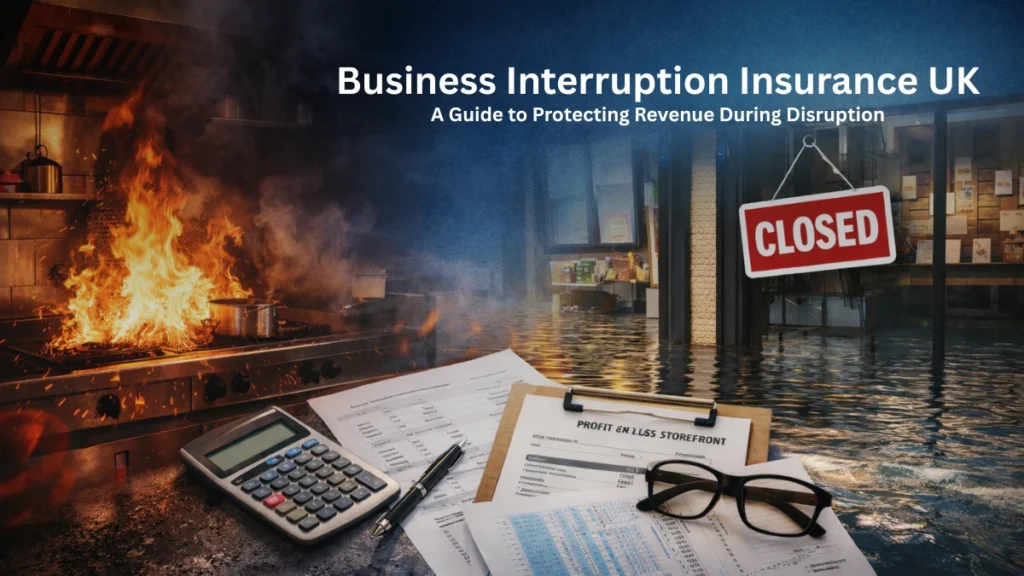
A fire damages a restaurant kitchen in Birmingham. Flooding forces a retail shop in Manchester to close for weeks. A burst pipe shuts down a small manufacturing unit in Leeds. In each case, the physical damage is only part of the problem. Lost revenue, ongoing wages and rent obligations can quickly create financial strain. That is where business interruption insurance UK becomes critical.
In 2026, with supply chain volatility and climate-related events continuing to affect operations, SMEs are increasingly reviewing how they would cope if trading stopped temporarily. Business interruption cover is designed to protect income — not just buildings and equipment.
Here is what UK business owners need to understand before arranging cover.
What Is Business Interruption Insurance UK?
Business interruption insurance UK policies provide financial support if your business cannot operate due to insured damage.
It typically covers:
- Loss of gross profit
- Ongoing fixed expenses
- Staff wages
- Temporary relocation costs
The trigger is usually physical damage covered under a separate property insurance policy.
This cover aims to place the business in the financial position it would have been in had the interruption not occurred.
It is particularly relevant for businesses reliant on physical premises.
How Business Interruption Insurance UK Works
When arranging business interruption cover:
- You estimate your gross profit and operating expenses.
- You select an indemnity period (often 12–24 months).
- The insurer calculates premium based on risk exposure.
- Cover begins once agreed.
If an insured event (such as fire or flood) prevents trading, the insurer compensates for lost income during the recovery period.
The indemnity period determines how long payments continue.
Choosing an appropriate indemnity period is crucial.
Business Interruption Insurance UK vs Property Insurance
Understanding the distinction is important.
| Feature | Property Insurance | Business Interruption |
| Covers Building Damage | Yes | No |
| Covers Lost Income | No | Yes |
| Trigger | Physical damage | Physical damage |
| Purpose | Asset protection | Revenue protection |
Property insurance repairs damage.
Business interruption replaces lost income resulting from that damage.
Our guide to business insurance UK explains how these policies work together.
Premiums Business Interruption Insurance UK Companies Pay
Premiums business interruption insurance UK providers charge depend on:
- Industry sector
- Annual turnover
- Gross profit levels
- Property location
- Claims history
- Indemnity period chosen
Higher-risk sectors such as hospitality may face higher premiums.
Longer indemnity periods increase cost but provide extended protection.
Premiums are generally paid annually.
Comparing quotes ensures competitive pricing.
Eligibility Business Interruption Insurance UK Criteria
Eligibility business interruption insurance UK insurers assess typically includes:
- Type of business activity
- Dependency on premises
- Supply chain exposure
- Past claims record
- Risk management practices
Businesses must hold underlying property insurance.
Insurers may review business continuity plans during underwriting.
Accurate turnover disclosure is essential.
Requirements Business Interruption Insurance UK Applications Involve
Applicants usually provide:
- Turnover figures
- Gross profit calculations
- Fixed expense details
- Property insurance information
- Claims history
Limited companies must supply Companies House registration details.
Policies are regulated by the Financial Conduct Authority.
Financial documentation supports accurate coverage limits.
Fees Business Interruption Insurance UK Policies Include
Business interruption insurance UK policies generally involve:
- Annual premium
- Excess per claim
- Policy amendment fees
- Optional extension charges
Extensions may include supplier or customer interruption cover.
Higher excess can reduce premium cost.
Understanding sub-limits ensures realistic expectations.
Risks of Not Having Business Interruption Insurance UK
Physical damage alone is often manageable.
Revenue loss creates deeper financial strain.
Key risks include:
- Inability to pay staff
- Ongoing rent obligations
- Loan repayment pressure
- Loss of market share
Let’s be realistic. Many SMEs operate with limited cash reserves.
Even a few weeks of lost income can create liquidity challenges.
Without business interruption cover, recovery may be slower and financially painful.
Business Interruption Insurance UK and Commercial Lending
Businesses with loans or asset finance arrangements may face ongoing repayment obligations during disruption.
Our coverage of commercial lending regulations UK highlights how financial commitments continue even during operational downtime.
Business interruption cover can support repayment continuity during temporary closure.
Lenders may view comprehensive insurance positively when assessing creditworthiness.
Business Interruption Insurance UK for SMEs
SMEs often underestimate the recovery period following major damage.
Repair delays, planning permissions and supply shortages can extend closure.
At The London Report, we observe that selecting too short an indemnity period is a common mistake.
Choosing 24 months instead of 12 months may better reflect realistic recovery timelines.
Proper gross profit calculation is equally important.
Extensions and Optional Add-Ons
Some policies offer additional protection such as:
- Supplier failure cover
- Utility service interruption
- Infectious disease extensions
- Denial of access cover
Policy wording should be reviewed carefully.
Not all extensions are included automatically.
Clear understanding prevents claim disputes.
When Business Interruption Insurance UK Makes Strategic Sense
This cover is particularly important when:
- Operating from fixed premises
- Employing staff
- Carrying ongoing rent or loan commitments
- Relying heavily on physical location for revenue
It may be less relevant for fully remote digital businesses with minimal fixed overheads.
Risk profile determines necessity.
Managing Business Interruption Insurance Responsibly
To maintain effective protection:
- Review turnover figures annually
- Update insurer after expansion
- Recalculate gross profit accurately
- Align indemnity period with realistic recovery timeline
Financial exposure evolves as business grows.
Insurance must reflect operational scale.
Conclusion
Does Your Business Need Business Interruption Insurance UK?
A business interruption insurance UK policy protects revenue when physical damage disrupts operations.
However, premiums business interruption insurance UK providers charge, eligibility business interruption insurance UK criteria, and requirements business interruption insurance UK applications involve must all be assessed carefully.
For premises-based SMEs, this cover provides critical financial continuity. Without it, even short-term disruption can create serious cash flow strain.
Professional advice and regular review remain essential in 2026.
FAQs
1. What triggers business interruption insurance UK?
Typically, insured physical damage to your business premises.
2. Does it cover pandemics?
Cover depends on policy wording and specific extensions.
3. How long does it pay out?
Up to the selected indemnity period, often 12 or 24 months.
4. Is it legally required?
No, but it is often advisable for premises-based businesses.
5. Are insurers regulated?
Yes, UK insurance providers are regulated by the Financial Conduct Authority.
Author Bio
The London Report Editorial Team provides authoritative insight on UK business insurance, financial resilience and regulatory compliance, supporting informed decisions for British SMEs.
Disclaimer
This article is for informational purposes only and does not constitute legal or financial advice. Businesses should seek independent professional guidance before purchasing insurance. Contact us if information requires correction or updating.