

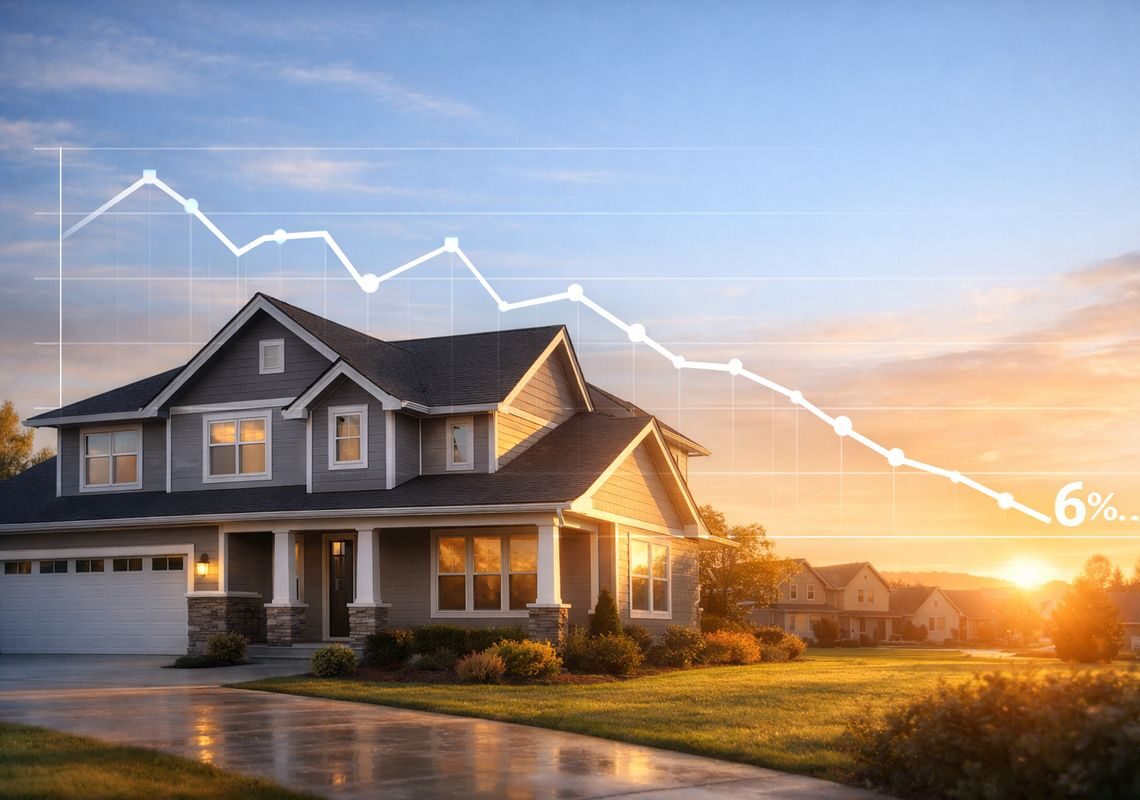
Over the past few years, mortgage rates have kept buyers and homeowners in a holding pattern — rising fast, easing briefly, then rising again. As 2026 begins, that cycle is changing. Rates are no longer surging, but they aren’t settling into a clear downward trend either.
Some forecasts point to mortgage rates dipping below 6%, with occasional speculation about the mid-5% range. Others caution that any improvement may be brief. That leaves borrowers facing a practical question in 2026: is it better to wait for lower rates, or act when conditions align? This forecast breaks that down.
Bottom Line: What 2026 Really Looks Like for Mortgage Rates
Most major housing and finance publications agree that mortgage rates in 2026 are likely to average around 6%, with temporary dips into the high-5% range and periodic rebounds above that level. Analysts at Bankrate and Investopedia both emphasize that any relief is likely to come in short windows rather than a sustained downtrend.
A prolonged return to 5% mortgage rates would likely require a sharper economic slowdown than most forecasts currently anticipate — a point echoed across Bankrate, Investopedia, and CBS News housing coverage.
Where Mortgage Rates Are Starting 2026
Mortgage rates entered 2026 at their lowest levels since 2022. According to weekly survey data from Freddie Mac, the average 30-year fixed mortgage rate has fallen to just above 6%, down nearly a full percentage point from early 2025.
Financial outlets such as Economic Times (U.S. edition) and MarketWatch have highlighted this drop as a meaningful shift, noting that it has already reduced monthly payments and reopened refinancing conversations for borrowers who bought at higher rates in recent years.
This improvement, however, still leaves rates well above the historic lows of 2020–2021, which most economists now describe as an anomaly rather than a baseline.
Mortgage Rate Forecast 2026: Expect Movement, Not a Miracle
Rather than predicting a single number, most forecasts describe a broad trading range for 2026.
According to projections published by Bankrate, mortgage rates are expected to:
- Average around 6.1%
- Reach potential lows near 5.7%
- Occasionally climb toward 6.5%
This range-based outlook is also supported by reporting from Investopedia, which notes that mortgage rates tend to fluctuate throughout the year as inflation data, labor market reports, and bond yields shift.
Could Mortgage Rates Touch 5% in 2026?
The idea of mortgage rates touching 5% has gained traction in recent headlines, particularly after commentary from analysts cited by Bankrate, CBS News, and Economic Times.
Some institutional forecasts — including those discussed by Morgan Stanley strategists in financial media coverage — suggest that if economic growth slows and inflation continues to cool, mortgage rates could briefly dip into the mid-5% range, most likely around mid-2026.
However, nearly all sources caution that sustained rates near 5% are unlikely without a more pronounced economic downturn. As Investopedia notes, the conditions that push rates down often reverse once borrowing and housing activity pick up.
Why Mortgage Rates Might Ease in 2026
Mortgage rates are driven less by headlines and more by bond market behavior.
As explained in analysis from Investopedia and MarketWatch, mortgage rates closely track long-term Treasury yields. When investors grow cautious — due to slower growth or easing inflation — demand for long-term bonds increases, pushing yields (and mortgage rates) lower.
Policy expectations also play a role. While the Federal Reserve does not directly set mortgage rates, coverage from Bankrate and CBS News shows that even modest shifts in Fed guidance can influence long-term rate expectations.
Read Also: Lifestyle Vinyl Flooring: The Complete UK Guide to Stylish, Durable & Affordable Flooring
Why Any Dip Below 6% May Not Stick
A consistent theme across Bankrate, Investopedia, and Freddie Mac commentary is that lower mortgage rates tend to revive the very activity that pushes them back up.
When rates fall:
- Buyer demand increases
- Home sales improve
- Economic confidence strengthens
- Investors move away from safe-haven assets
As noted in multiple Investopedia analyses, this often causes Treasury yields to rise again — pulling mortgage rates higher in the process. This feedback loop is why analysts describe 2026 as a volatile transition year rather than the start of a new low-rate era.
What Lower Rates Mean for the Housing Market
Lower mortgage rates would improve affordability at the margins, but they won’t solve deeper housing challenges. According to housing economists quoted by Bright MLS, Bankrate, and MarketWatch, even a dip below 6% could quickly bring more buyers into the market — increasing competition and putting upward pressure on prices.
That’s why many experts describe 2026 as a year of gradual reactivation, not a housing boom.
Who Benefits Most in 2026
- First-time buyers: Lower rates help monthly payments, but increased competition could offset some gains — a dynamic highlighted in Bankrate’s buyer guidance.
- Homeowners with high-rate mortgages: Those who bought in 2023–2024 may finally find refinancing worthwhile if rates dip into the mid-5% or low-6% range, a scenario discussed in Freddie Mac and CBS News coverage.
- Homeowners with ultra-low rates: As noted repeatedly by Investopedia, this group is still unlikely to move based on rates alo
Final Take
Across Bankrate, Investopedia, Freddie Mac, CBS News, MarketWatch, and Economic Times, the message is consistent: 2026 offers potential relief, but not certainty.
Mortgage rates may dip, rebound, and dip again — sometimes quickly. The borrowers who benefit most won’t be the ones who perfectly time the market, but those who are financially prepared and flexible enough to act when conditions align.
In 2026, being ready matters more than being predictive — and that’s the real trend shaping the mortgage market.
Frequently Asked Questions (FAQs)
What might mortgage rates be in 2026?
Most forecasts from Bankrate and Investopedia suggest mortgage rates in 2026 will average around 6%, with fluctuations roughly between 5.5% and 6.5%.
Will interest rates go down in 2026 for mortgages?
Mortgage rates may decline at certain points in 2026, particularly if inflation cools further, according to analysis from Bankrate and CBS News. However, steady declines are not expected.
Will interest rates rise in 2026?
Yes. Experts quoted by Investopedia warn that stronger economic data or renewed inflation pressure could push mortgage rates higher at various points during the year.
Should I lock in my mortgage rate for 5 years?
Bankrate advises that locking in can make sense for borrowers who value payment certainty, especially when rates are near the lower end of the projected range.
Will mortgage rates go down in 2027?
Outlooks from Bankrate and Fannie Mae suggest mortgage rates could ease further in 2027, but a rapid return to historically low levels is unlikely without major economic disruption.