


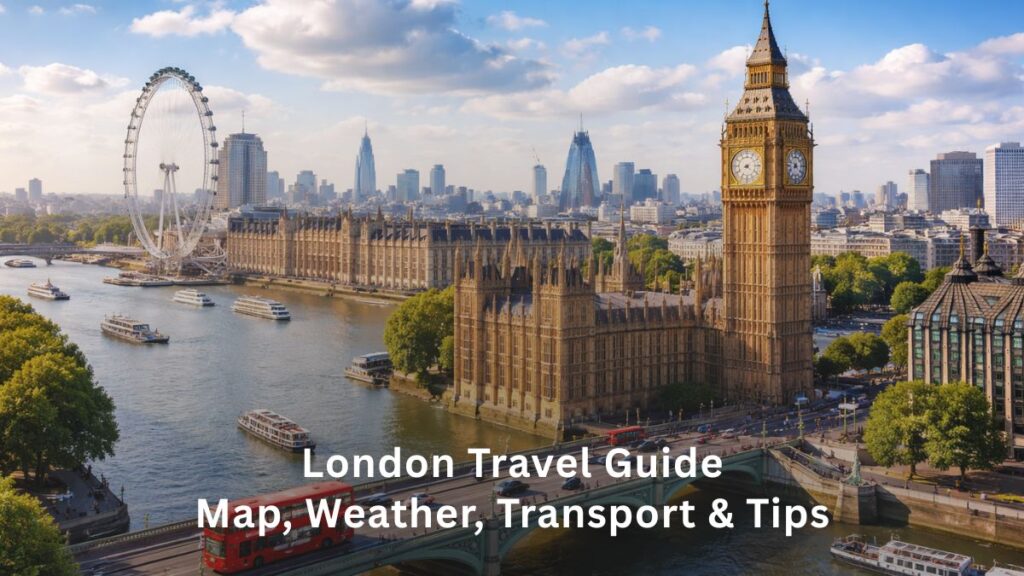
London is one of those cities that people feel they already know before they arrive. Perhaps you’ve seen it in films, read about its royal history, or watched the red double-decker buses rolling past famous landmarks. Yet the moment you step out of a Tube station and hear the hum of the city around you, London reveals itself as something far bigger and more fascinating.
For first-time visitors, the capital can feel overwhelming. It’s huge, historic, modern, chaotic and charming all at the same time. That’s exactly why having a proper London Travel Guide helps. Understanding where the city sits on the map, how the transport works, what the weather is like, and which areas are worth exploring makes the experience far smoother.
This guide brings together the essential information every traveller or curious reader should know about London — from its location and population to transport tips and the best things to see.
Where is London Located
London sits in the south-east of England and is the capital city of the United Kingdom. It lies along the River Thames, which winds through the centre of the city and has shaped London’s development for centuries.
Geographically, London is about 80 kilometres from the North Sea coast and sits roughly halfway between continental Europe and the rest of the British Isles. Its location made it a powerful trading hub long before the modern era. Ships once travelled up the Thames carrying goods from around the world, helping London grow into one of the most important cities on the planet.
Today the city spreads across a vast metropolitan area known as Greater London. This includes 32 boroughs plus the historic City of London, the small financial district often referred to as “the Square Mile”.
If you look at a map of Europe, London sits conveniently close to major cities like:
- Paris
- Brussels
- Amsterdam
Thanks to the Channel Tunnel and extensive air connections, London remains one of Europe’s most accessible and internationally connected capitals.
London Population
London is one of the most populated and diverse cities in Europe. The population of Greater London is estimated to be around 9 million people, though the wider metropolitan area is even larger.
What makes London particularly unique is its cultural diversity. People from more than 200 nationalities live in the city, and over 300 languages are spoken. Walking through different neighbourhoods can feel like travelling across the world without leaving the city.
For example:
- Southall is known for its large South Asian community.
- Chinatown near Leicester Square reflects London’s Chinese heritage.
- Brixton has strong Caribbean cultural roots.
Despite its size, London manages to feel like a collection of villages. Each borough and neighbourhood has its own character, local markets, cafés and parks.
For visitors, this diversity means an incredible range of experiences — from international cuisine and music scenes to cultural festivals throughout the year.
London Weather
Anyone who has spent time in the city knows that London weather has a personality of its own. It’s famously unpredictable, though not always as gloomy as people expect.
London has a temperate maritime climate, which means mild winters, comfortable summers and regular rainfall throughout the year.
Here’s a quick overview of typical conditions:
| Season | Average Temperature | What to Expect |
| Winter (Dec–Feb) | 2–8°C | Chilly, occasional frost, early sunsets |
| Spring (Mar–May) | 8–15°C | Blooming parks and changing weather |
| Summer (Jun–Aug) | 18–25°C | Warm days, busy parks and festivals |
| Autumn (Sep–Nov) | 10–16°C | Crisp air and colourful trees |
Rain is common but usually light rather than heavy. A short drizzle might pass through quickly before the sun reappears.
Seasonal highlights include:
- Spring blossoms in Hyde Park and Regent’s Park
- Summer outdoor events and rooftop bars
- Autumn walks along the Thames
- Festive Christmas lights across the West End
Most visitors quickly learn the unofficial London rule: always carry a small umbrella.
Current Time in London
London operates on Greenwich Mean Time (GMT) during winter months and switches to British Summer Time (BST) during daylight saving.
Daylight saving usually begins in late March and ends in late October, moving the clocks one hour forward in spring and one hour back in autumn.
London’s time zone has historical significance because the Prime Meridian runs through the Royal Observatory in Greenwich. This line divides the eastern and western hemispheres of the Earth.
For centuries, GMT served as the global standard for timekeeping. Even today, many international systems and aviation schedules still reference Greenwich time.
Visitors may notice longer daylight hours in summer. Around June, the sun can remain visible until nearly 9:30 pm, giving travellers more time to explore the city in the evening.
London Map and Areas
Looking at a London map for the first time can be surprising. The city is far larger than many people expect, and its neighbourhoods spread out in every direction.
The River Thames cuts through the city from west to east, acting as a natural landmark that helps people navigate the capital.
London is typically divided into several main areas:
Central London
This is where most major attractions are located. Areas include:
- Westminster
- Covent Garden
- Soho
- South Bank
Visitors often spend the majority of their trip here.
North London
North London offers a more residential feel with cultural highlights.
Notable places include:
- Camden
- Islington
- Hampstead
East London
Once industrial, East London has transformed into one of the city’s trendiest districts.
Popular areas include:
- Shoreditch
- Hackney
- Stratford
West London
Known for leafy streets and elegant architecture.
Famous locations include:
- Kensington
- Notting Hill
- Chelsea
South London
Often overlooked by tourists but full of character.
Key neighbourhoods include:
- Greenwich
- Brixton
- Clapham
Understanding these areas makes navigating London far easier.
Airports in London
London is served by several international airports, making it one of the best connected cities in the world.
Here are the main airports travellers use:
| Airport | Distance from Central London | Key Notes |
| Heathrow | ~24 km | Largest airport, major global hub |
| Gatwick | ~45 km | Popular for European and budget flights |
| Stansted | ~64 km | Frequent low-cost airline routes |
| Luton | ~56 km | Budget airlines and short-haul flights |
| London City | ~11 km | Closest to the financial district |
Heathrow is the busiest and handles most long-haul flights.
London City Airport is particularly convenient for business travellers because it sits close to Canary Wharf and the City financial district.
Most airports connect to central London through trains, Tube lines, buses or express rail services.
Transport in London
If there’s one thing Londoners know well, it’s how to get around the city. The capital has one of the most extensive public transport networks in the world.
The London Underground
Often called the Tube, this system dates back to 1863 and remains the fastest way to cross the city.
Key features include:
- 11 lines covering most of Greater London
- Frequent trains
- Clear colour-coded maps
During rush hour, trains can become extremely busy, especially on central lines.
Buses
London’s red double-decker buses are iconic and surprisingly useful for visitors.
Advantages include:
- Extensive routes across the city
- Cheaper fares than the Tube
- Great views from the top deck
Overground and Rail
London Overground trains connect outer boroughs and help link areas not served by the Underground.
Contactless Payment
Transport in London is easy thanks to contactless payments.
Visitors can use:
- Contactless debit or credit cards
- Mobile payments
- Oyster cards
Daily caps ensure you won’t pay more than a certain amount for travel.
Things to Do in London
London offers an extraordinary mix of historic landmarks, cultural attractions and modern experiences.
Many first-time visitors start with the city’s most famous sights.
Historic Landmarks
London’s history stretches back nearly 2,000 years.
Popular attractions include:
- Buckingham Palace
- Tower of London
- Westminster Abbey
- St Paul’s Cathedral
Each tells a different chapter of the city’s story.
Museums and Galleries
One of the best things about London is that many world-class museums are free to enter.
Highlights include:
- The British Museum
- Natural History Museum
- Tate Modern
- National Gallery
These institutions house some of the most important collections in the world.
Parks and Outdoor Spaces
London is surprisingly green.
Large parks such as:
- Hyde Park
- Regent’s Park
- Greenwich Park
provide space to relax away from the busy streets.
Markets and Food
Markets are an essential part of London life.
Some favourites include:
- Borough Market for food lovers
- Camden Market for street culture
- Portobello Road Market for antiques
Trying international street food while wandering through these markets is a memorable London experience.
Theatre and Entertainment
London’s West End rivals Broadway with its world-class theatre productions.
Shows, musicals and performances run throughout the year, making it one of the best cultural scenes in Europe.
Whether you enjoy history, art, shopping, nightlife or simply exploring neighbourhoods, London offers something for every type of traveller.
Conclusion
London is a city that blends centuries of history with modern global energy. From its position along the River Thames to its multicultural population, ever-changing weather and world-famous transport system, the capital remains one of the most fascinating places to visit or explore.
A good London guide helps make sense of this enormous city. Understanding the main areas, airports, transport options and attractions allows visitors to navigate London with confidence.
Whether you’re planning your first trip or simply learning more about the UK’s capital, London continues to reward curiosity. Every street corner seems to reveal another story, another landmark or another hidden café waiting to be discovered.
FAQs
What is London best known for
London is known for historic landmarks like Buckingham Palace, the Tower of London, Big Ben, world-class museums, theatre in the West End, and its multicultural atmosphere.
How many people live in London
Greater London has a population of around 9 million residents, making it one of the largest and most diverse cities in Europe.
What is the best time to visit London
Spring and early autumn are often considered the best times to visit London due to mild temperatures, fewer crowds and pleasant weather.
How do tourists get around London
Most visitors use the London Underground, buses, trains and contactless payment systems like Oyster cards or bank cards for convenient travel across the city.
Which airport is closest to central London
London City Airport is the closest airport to central London, located about 11 kilometres from the city centre.
Author Bio
The London Report Editorial Team writes in-depth guides about London, covering travel, lifestyle, neighbourhood insights and practical information to help both visitors and locals better understand the UK’s capital city.
Disclaimer
Information in this guide is based on current public sources and local knowledge. Details such as transport services, opening hours or travel rules may change. Readers are welcome to contact us if updates or corrections are required.