
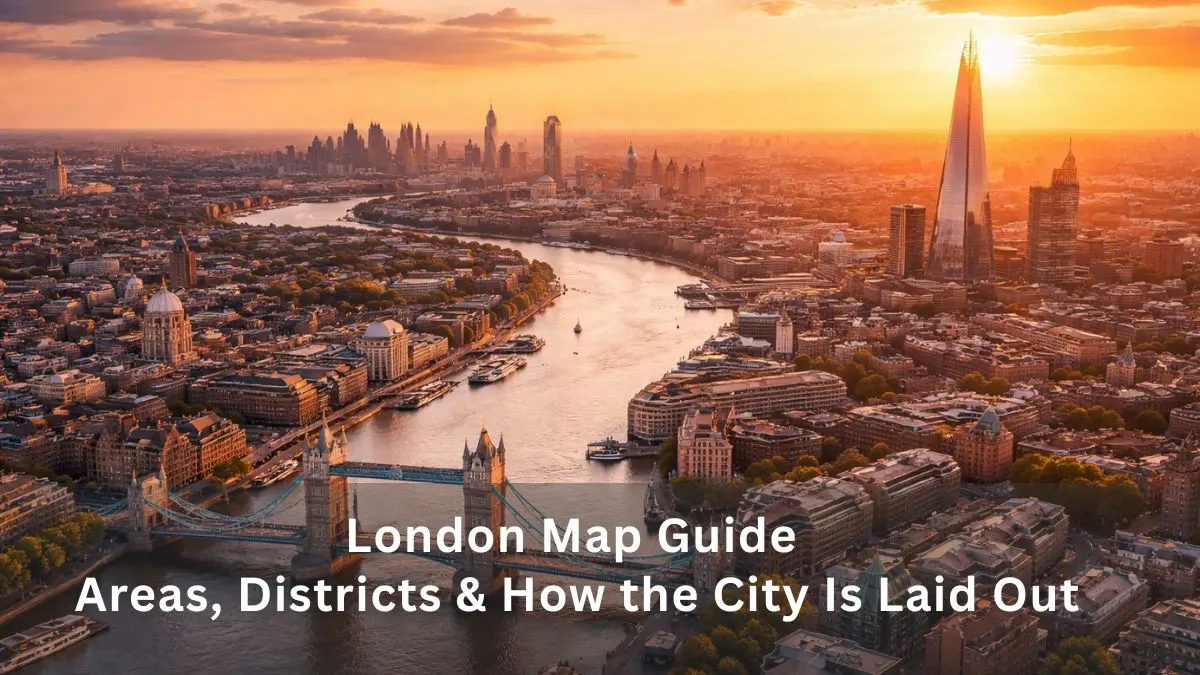
Open a map of London for the first time and it can feel slightly overwhelming. The city spreads across a huge area, with dozens of neighbourhoods, winding streets, historic districts and the River Thames weaving its way through the middle. Unlike some modern cities built on neat grid systems, London grew over centuries — and its map reflects that long and fascinating history.
Understanding the London map helps make sense of how the capital works. Knowing where the main districts are, how the river divides the city, and how the boroughs fit together can make travelling around far easier. It also explains why some areas feel distinctly different from others.
From the historic streets around Westminster to the creative neighbourhoods of East London, the capital is really a collection of villages connected by one enormous transport network. Once you understand the map, exploring London becomes much simpler.
Understanding the Layout of London
London is built around the River Thames, which flows from west to east through the centre of the city before reaching the North Sea.
The river acts as a natural reference point that helps people navigate the capital. When Londoners describe locations, they often refer to whether an area is north of the river or south of the river.
Historically, the earliest parts of the city developed near the river because it allowed trade and transport. Over time, the urban area expanded outward in all directions.
Today, Greater London covers about 1,572 square kilometres, making it one of the largest metropolitan areas in Europe.
Because the city expanded gradually over hundreds of years, its street patterns are often irregular. You’ll find narrow medieval lanes sitting beside wide Victorian avenues and modern skyscraper districts.
Understanding this layered history helps explain why London’s map looks so different from many newer cities.
Central London
Most visitors spend much of their time in Central London, which contains the capital’s most famous landmarks and historic districts.
Central London is not an official administrative region, but it usually refers to the areas surrounding the River Thames in the heart of the city.
Key districts include:
- Westminster
- Soho
- Covent Garden
- South Bank
- Mayfair
- Holborn
These neighbourhoods contain many well-known attractions such as Buckingham Palace, the Houses of Parliament and Trafalgar Square.
Central London is also where you’ll find many theatres, museums, restaurants and shopping streets.
Because so many transport routes converge here, the area is extremely busy throughout the day and evening.
North London
North London stretches above the River Thames and includes a mixture of residential neighbourhoods, historic districts and cultural hubs.
This part of the city often feels more relaxed than central areas, though it still offers plenty to explore.
Some notable neighbourhoods include:
- Camden
- Islington
- Hampstead
- Highbury
- Finchley
Camden is famous for its alternative culture and lively market scene, while Hampstead offers a quieter atmosphere with leafy streets and the large green space of Hampstead Heath.
North London also contains many residential communities where locals live, work and socialise away from the main tourist crowds.
East London
East London has undergone one of the most dramatic transformations in the city.
Historically, this area was known for docks, factories and working-class neighbourhoods linked to London’s shipping industry. In recent decades, however, East London has become one of the capital’s most creative and energetic districts.
Popular neighbourhoods include:
- Shoreditch
- Hackney
- Stratford
- Bethnal Green
- Canary Wharf
Shoreditch is particularly well known for its street art, independent cafés and technology startups.
Canary Wharf, by contrast, is a modern financial district filled with skyscrapers and major international banks.
The area around Stratford was also redeveloped for the 2012 Olympic Games, adding new parks, housing and shopping centres.
West London
West London is often associated with elegant streets, museums and some of the city’s most famous residential neighbourhoods.
This part of London contains several of the capital’s most well-known districts:
- Kensington
- Chelsea
- Notting Hill
- Hammersmith
- Fulham
Kensington is home to major cultural institutions such as the Natural History Museum and the Victoria and Albert Museum.
Notting Hill is recognised for its colourful houses and the famous Portobello Road Market.
Many embassies, historic townhouses and leafy garden squares are located in West London, giving the area a distinctive character.
South London
South London lies below the River Thames and has a reputation for being diverse, creative and full of character.
Although it sometimes receives less attention from tourists, this part of the city offers many fascinating neighbourhoods and attractions.
Notable areas include:
- Greenwich
- Brixton
- Clapham
- Dulwich
- Peckham
Greenwich is particularly famous because it is home to the Prime Meridian and the Royal Observatory.
Brixton is known for its strong Caribbean heritage and lively food markets, while Clapham attracts many young professionals.
In recent years, neighbourhoods such as Peckham have developed thriving arts and cultural scenes.
Greater London Boroughs
Greater London is divided into 32 boroughs, each with its own local council and identity.
These boroughs form the administrative structure that governs the wider metropolitan area.
Examples include:
| Borough | Location |
| Camden | North London |
| Westminster | Central London |
| Croydon | South London |
| Barnet | North London |
| Newham | East London |
Each borough manages local services such as schools, housing, waste collection and community planning.
At the city-wide level, the Mayor of London and the Greater London Authority coordinate larger policies related to transport, development and the environment.
The River Thames as a Navigation Guide
The River Thames is not only a historic trade route but also one of the easiest ways to understand the London map.
Many of the city’s most famous landmarks sit along the riverbanks, including:
- Tower Bridge
- The London Eye
- Westminster Bridge
- St Paul’s Cathedral
- The Tower of London
Several major bridges connect the north and south sides of the city, helping transport routes flow across the river.
Popular bridges include:
- London Bridge
- Tower Bridge
- Waterloo Bridge
- Westminster Bridge
For visitors, walking along the riverside paths offers one of the best ways to understand the layout of the city.
The Thames Path allows people to explore large sections of central London while passing major landmarks.
How Transport Shapes the London Map
London’s transport network plays a major role in how the city is organised.
The London Underground, often called the Tube, connects most major districts through a network of colour-coded lines.
Many neighbourhoods grew around Underground stations, which means transport access often determines how busy an area becomes.
For example:
- Canary Wharf expanded rapidly after the Jubilee Line extension.
- Stratford became a major transport hub after new rail links were added.
In addition to the Underground, London also relies on:
- Overground rail lines
- National rail services
- Red double-decker buses
- River boat services
Because of this network, even areas located several kilometres from the centre remain well connected.
Why Understanding the London Map Helps Visitors
For travellers, learning the basic layout of the city makes exploring far easier.
Rather than memorising dozens of neighbourhood names, it helps to understand the broader structure:
- Central London for major attractions
- North London for cultural districts
- East London for creativity and nightlife
- West London for museums and historic streets
- South London for diverse communities and parks
Once you recognise these regions, navigating the city becomes far more intuitive.
Visitors quickly realise that London isn’t a single concentrated centre but a vast collection of neighbourhoods, each offering its own atmosphere and experiences.
Conclusion
Understanding the London map reveals how this enormous city fits together. Built around the River Thames and expanded over centuries, London developed into a network of distinct neighbourhoods rather than a single central district.
From historic Westminster and lively Soho to creative Shoreditch and elegant Kensington, each area adds something unique to the capital’s character.
Although the city can seem complex at first glance, its structure becomes surprisingly easy to understand once you recognise the major regions and transport connections. With a map in hand — or simply a good sense of direction — exploring London soon becomes part of the adventure.
FAQs
1. How big is London
Greater London covers about 1,572 square kilometres and includes 32 boroughs plus the historic City of London.
2. What is Central London
Central London refers to the main area around the River Thames where many major attractions, government buildings and cultural landmarks are located.
3. Is the River Thames in the middle of London
Yes. The River Thames flows through central London from west to east, dividing the city into northern and southern sections.
4. How many boroughs are in London
Greater London is divided into 32 boroughs along with the City of London financial district.
6. Which part of London is best for tourists
Central London areas such as Westminster, Covent Garden, Soho and the South Bank are popular with visitors because they contain many famous attractions.
Author Bio
The London Report Editorial Team creates expert guides about London’s neighbourhoods, travel information, culture and history to help readers explore and understand the UK’s capital city.
Disclaimer
Information in this guide is based on general geographic and administrative data about London. Boundaries, borough details and transport developments may change over time.