
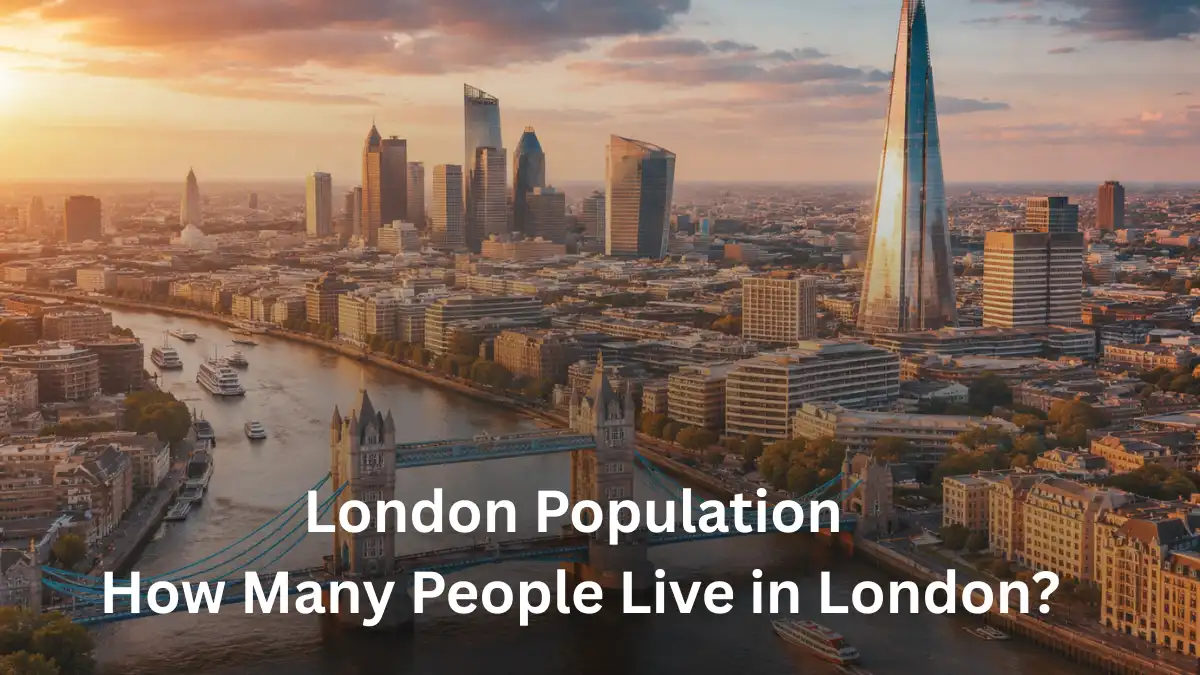
Walk through any busy street in London — whether it’s Oxford Circus during rush hour or a weekend market in Camden — and one thing becomes immediately clear: this is a city full of life. People from every corner of the world move through the capital every day, creating one of the most dynamic urban populations anywhere on the planet.
But how many people actually live here? The London population is often larger than many visitors expect. As the capital of the United Kingdom and one of the world’s leading global cities, London attracts residents, students, professionals and entrepreneurs from across the globe.
Understanding the size of London’s population also helps explain the city itself — its housing challenges, transport systems, cultural diversity and economic influence. From historic growth during the Industrial Revolution to modern migration trends, the population of London tells a fascinating story about how this city became one of the largest and most multicultural capitals in the world.
Current Population of London
The estimated population of Greater London is around 9 million people. This makes London the largest city in the United Kingdom and one of the most populated metropolitan areas in Europe.
Greater London covers the wider metropolitan region governed by the Mayor of London and includes 32 boroughs plus the historic City of London financial district.
To understand the scale of London’s population, it helps to compare it with other major UK cities:
| City | Population (Approx.) |
| London | ~9 million |
| Birmingham | ~1.1 million |
| Manchester | ~550,000 |
| Glasgow | ~635,000 |
| Liverpool | ~500,000 |
As the table shows, London’s population is dramatically larger than any other British city.
During working hours, the population in central London increases even further as commuters travel in from surrounding counties such as Essex, Surrey, Hertfordshire and Kent.
On busy weekdays, millions of additional people move through the capital’s offices, universities and tourist attractions.
Population Growth Over Time
London’s population has not always been this large. The city has grown steadily for centuries, shaped by trade, industry and global migration.
Here is a simplified timeline of London’s population growth:
| Year | Estimated Population |
| 1800 | ~1 million |
| 1900 | ~6.5 million |
| 1939 | ~8.6 million |
| 1980 | ~6.8 million |
| 2020s | ~9 million |
During the Industrial Revolution, London experienced rapid growth as people moved to the city for work in factories, trade and shipping industries.
By the early 20th century, London had become the largest city in the world.
After World War II, population levels temporarily declined as people moved to suburban towns and new cities outside London.
However, from the 1990s onward the population began growing again due to international migration, economic opportunities and the expansion of London’s financial sector.
Today London remains one of Europe’s fastest-growing major cities.
Greater London vs City of London
One of the most confusing aspects when discussing the London population is the difference between Greater London and the City of London.
These are two very different administrative areas.
| Area | Population | Description |
| Greater London | ~9 million | The entire metropolitan region |
| City of London | ~9,000 residents | Historic financial district |
The City of London, often called the Square Mile, is the historic centre of the city and home to London’s financial institutions.
Although only a few thousand people live there permanently, the daytime population can exceed 500,000 workers as bankers, traders and office staff arrive each morning.
Most of London’s residential population lives in the surrounding boroughs such as Camden, Croydon, Barnet and Lambeth.
Population by London Borough
Greater London is divided into 32 boroughs, each with its own population size and local government.
Some boroughs are particularly large and densely populated.
Here are a few of the most populated boroughs:
| Borough | Estimated Population |
| Croydon | ~390,000 |
| Barnet | ~395,000 |
| Ealing | ~345,000 |
| Newham | ~355,000 |
| Brent | ~340,000 |
These boroughs contain large residential communities, housing developments and local business districts.
Central London boroughs such as Westminster and Kensington have smaller residential populations but attract large numbers of workers and tourists.
Because London is so vast, population density varies greatly between neighbourhoods. Some areas feel like bustling city centres, while others resemble quiet suburban communities with parks and family homes.
London’s Cultural Diversity
One of the defining features of London’s population is its extraordinary diversity.
More than 300 languages are spoken across the capital, making it one of the most multicultural cities in the world.
According to UK statistics, around 40% of London residents were born outside the United Kingdom.
Communities from across the globe have shaped the city’s culture, food and neighbourhoods.
Examples include:
- Caribbean communities in Brixton
- South Asian communities in Southall and Wembley
- Chinese communities near Chinatown and parts of East London
- Turkish communities in areas such as Hackney
This cultural mix gives London its unique atmosphere.
Visitors often notice that you can hear several languages spoken on a single Tube journey. Restaurants, festivals and markets reflect traditions from around the world.
It’s one of the reasons London continues to attract international residents.
Population Density in London
Despite its enormous population, London covers a very large area.
Greater London spans approximately 1,572 square kilometres, which spreads residents across many districts and neighbourhoods.
Still, certain parts of the city are extremely dense.
Central areas such as:
- Westminster
- Camden
- Islington
- Tower Hamlets
have high population density because of apartment buildings and limited space.
Outer boroughs such as Bromley or Richmond feel much more suburban, with quieter streets, larger homes and more green space.
This mix of urban density and suburban neighbourhoods gives London a unique structure compared with other global capitals.
In many ways, the city feels like a network of smaller communities connected by transport rather than a single continuous metropolis.
Commuters and Daytime Population
London’s population changes dramatically throughout the day.
Each morning, large numbers of commuters travel into the city from surrounding regions.
These commuters come from areas such as:
- Essex
- Kent
- Surrey
- Hertfordshire
- Buckinghamshire
They arrive by train, Underground, bus and car to work in offices, government buildings and financial institutions.
As a result, central London’s daytime population can increase by millions of people during working hours.
The City of London financial district is the clearest example. Only a few thousand residents live there, yet hundreds of thousands of professionals work in the area each day.
Tourists also add to the population. London typically welcomes tens of millions of visitors annually, further increasing activity in central districts.
Why London’s Population Continues to Grow
Several factors explain why London’s population continues to expand.
Economic Opportunities
London remains one of the world’s largest financial and business centres, attracting workers from across the UK and abroad.
Education
Top universities such as University College London and King’s College London draw international students who often remain in the city after graduating.
Global Connectivity
London’s airports, international companies and cultural influence make it an attractive place to live and work.
Cultural Lifestyle
From theatre in the West End to markets, museums and restaurants, London offers an urban lifestyle that appeals to people of many backgrounds.
These factors continue to attract new residents despite the high cost of living in the capital.
Conclusion
The London population reflects the city’s status as one of the world’s most important global capitals. With around nine million residents across Greater London, it stands far ahead of other UK cities in both size and influence.
Yet the story of London’s population is about more than numbers. The city’s diverse communities, historic growth and constant flow of commuters and visitors all contribute to its unique energy.
Whether exploring busy markets, travelling on the Underground or walking through neighbourhood parks, it quickly becomes clear that London is a city shaped by people from all over the world. Its population continues to evolve — and that diversity remains one of the capital’s greatest strengths.
FAQs
1. What is the current population of London in 2026?
The population of Greater London is estimated to be around 9 million people, making it the largest city in the United Kingdom.
2. Why does London have such a large population?
London attracts people due to job opportunities, global business presence, top universities, and its diverse culture.
3. What is the difference between Greater London and the City of London?
Greater London includes the entire metropolitan area, while the City of London is a small financial district with a much smaller residential population.
4. How many boroughs are there in London?
London is divided into 32 boroughs along with the historic City of London.
5. Is London the biggest city in Europe?
London is one of the largest cities in Europe, though some cities like Moscow have a larger population.
6. What percentage of London residents are from outside the UK?
Around 40% of London’s residents were born outside the UK, making it highly multicultura
Author Bio
The London Report Editorial Team produces expert guides about London’s neighbourhoods, history, travel information and culture to help readers explore and understand the UK’s capital city.
Disclaimer
Information in this article is based on public demographic estimates and official statistics. Population figures may change as new census data becomes available. Readers are welcome to contact us for corrections or updates.