It started with a single saucepan and a tiny worktop. When Sarah moved into her first London flat, she imagined cooking cosy dinners every evening. The reality was different. Cupboards were packed with random gadgets she barely used, while the tools she really needed were missing. Preparing a simple pasta dinner felt harder than it should. After replacing clutter with a handful of practical essentials, her kitchen became easier to use, easier to clean, and far more enjoyable. Her story is one that many Londoners can relate to. Whether you live in a Victorian terrace, a modern apartment, or a compact studio, choosing the right essential kitchenware for London kitchens makes everyday cooking simpler. Instead of filling your cupboards with trendy gadgets, focus on quality, versatility, and smart storage. A well-planned kitchen doesn’t have to be large—it simply needs the right tools for the way you cook.
Why Every London Kitchen Deserves Smart, Practical Essentials
London homes come in all shapes and sizes, but one thing many kitchens share is limited space. From narrow galley kitchens in older homes to compact open-plan flats, every cupboard matters. That is why buying the right kitchen essentials UK households rely on is far more important than buying the biggest cookware set you can find.
The best kitchens are rarely the ones filled with gadgets. They are the kitchens where every item has a purpose. A sharp chef’s knife, a sturdy chopping board, a reliable frying pan, and a medium saucepan will handle most everyday meals. Whether you are making a quick stir-fry after work, preparing a traditional Sunday roast, or cooking a homemade curry, these core tools do the heavy lifting. Experienced home cooks often discover that a small collection of quality equipment performs better than dozens of single-use gadgets.
Storage also plays a huge role. Stackable pans, nesting mixing bowls, and airtight food containers keep cupboards organised while making cooking feel less stressful. If your home has a particularly small cooking space, clever layouts can make a remarkable difference. You can find inspiration in these kitchenette ideas, which show how thoughtful organisation can transform even the smallest kitchen into a practical space.
As your cooking habits grow, your kitchen should grow with them—not by becoming more crowded, but by becoming more efficient. Every carefully chosen tool saves time, reduces frustration, and helps you enjoy cooking instead of rushing through it.
Choosing Cookware That Works Every Single Day
One of the biggest mistakes first-time homeowners and renters make is buying an oversized cookware set because it seems like good value. A few months later, several pans are still untouched while the same two pieces are used almost every day. This happens because great kitchens are built around versatility, not quantity.
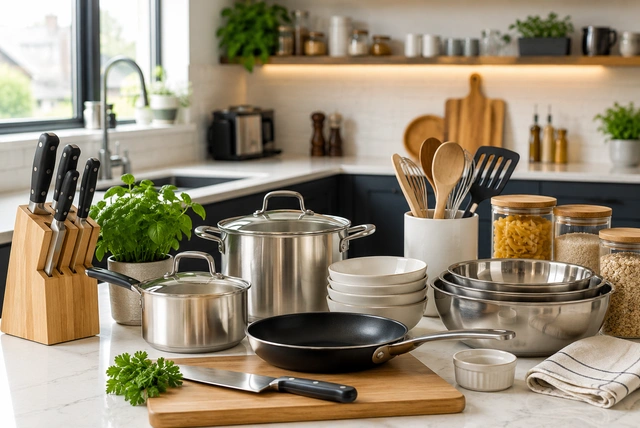
A quality non-stick frying pan is perfect for eggs, pancakes, vegetables, and delicate fish. A stainless-steel frying pan handles high-heat cooking and creates better browning for meat. Add a medium saucepan for soups, sauces, rice, and pasta, plus a larger stockpot for batch cooking, and you’ve already covered most meals. A sturdy baking tray completes the essentials, making it easy to roast vegetables, chicken, or potatoes in one go.
Modern cookware for small kitchens should also save space. Nesting pans, oven-safe cookware, and multifunctional casserole dishes reduce clutter while increasing flexibility. Many London flats now feature induction hobs, so checking compatibility before buying new pans is equally important. Investing in durable cookware may cost a little more initially, but replacing cheap pans every couple of years usually costs far more in the long run.
If you’re planning to update your kitchen alongside your cookware, pairing practical equipment with smart cabinetry can make everyday cooking even easier. Explore these ideas for modern kitchen laminate cabinets to create a clean, organised, and highly functional cooking space.
The Kitchen Tools You Will Reach for Every Day
When I first helped a friend set up her rented flat in East London, we laughed at how many fancy gadgets she had received as housewarming gifts. There was an avocado slicer, an electric egg cooker, and even a popcorn maker. Six months later, all of them were collecting dust. The tools she actually used every single day were surprisingly simple. That experience is a reminder that the best London kitchen tools are often the most basic ones.
A sharp chef’s knife is the heart of every kitchen because it makes chopping vegetables, slicing meat, and preparing herbs quicker and safer. Pair it with a small paring knife for peeling fruit and detailed tasks, and you’ve already solved most of your cutting needs. Add a sturdy wooden or bamboo chopping board, a silicone spatula, kitchen tongs, a whisk, measuring spoons, measuring cups, a vegetable peeler, and kitchen scissors, and you’ll be prepared for almost any recipe.
Another tool many home cooks overlook is a digital kitchen scale. It takes the guesswork out of baking and helps create consistent meals every time. A fine-mesh sieve, box grater, and mixing bowls complete a practical collection without taking up much space. Instead of buying every new kitchen gadget UK retailers advertise, focus on versatile tools that perform several jobs well. This approach keeps your kitchen organised while saving money in the long run.
Keeping these essentials organised is just as important. Drawer dividers, magnetic knife strips, and simple utensil holders reduce clutter and make cooking more enjoyable. A clean kitchen also protects your investment. Regularly maintaining appliances and ventilation prevents grease from building up, so it’s worth learning how to clean extractor fan filters as part of your regular kitchen routine.
Making a Small London Kitchen Feel Bigger and Better
Many Londoners dream of having a larger kitchen, but the truth is that space isn’t always the biggest challenge. Organisation is. Walk into two flats with exactly the same floor plan, and one may feel cramped while the other feels surprisingly spacious. The difference often comes down to choosing the right kitchen storage solutions and removing unnecessary clutter.
Imagine arriving home after a busy day at work. Instead of moving appliances just to prepare dinner, your worktop is clear because bulky gadgets are stored away or replaced with compact kitchen equipment. Your cookware stacks neatly inside one cupboard, spices are easy to find, and dry ingredients are stored in matching airtight containers. Cooking immediately becomes less stressful because everything has a place.
Vertical storage is one of the smartest ideas for compact British kitchens. Wall-mounted shelves, magnetic racks, over-the-door organisers, and under-shelf baskets create extra storage without taking up valuable floor space. Foldable colanders, nesting bowls, and oven-safe cookware also help maximise every cupboard. These small improvements are especially useful for renters who want to improve their kitchen without making permanent changes.
Keeping your kitchen clean is equally important. Natural cleaning products can help maintain worktops, sinks, and cookware while reducing harsh chemical use around food preparation areas. If you’re looking for a gentle cleaning option, you can read more about Nanna’s Secret Natural Cleaning Clay and how it can become part of your regular kitchen cleaning routine.
Remember, the goal isn’t to own more. It’s to own the right tools. A thoughtfully organised kitchen, even in a compact London flat, makes cooking easier, cleaning quicker, and everyday life much more enjoyable. Often, the smallest kitchens become the warmest places in the home because every item has a purpose and every meal feels effortless.
Why Buying Quality Kitchenware Saves Money in the Long Run
When people furnish their first kitchen, it’s tempting to buy the cheapest cookware available. It feels like a smart way to save money. I made the same mistake years ago, buying a large pan set because it looked like a bargain. Within a year, the non-stick coating had started peeling, the handles had become loose, and I was shopping for replacements all over again. That experience taught me that buying fewer, better-quality items is almost always the smarter choice.
British kitchenware made from stainless steel, carbon steel, or heavy-gauge aluminium often lasts much longer than cheaper alternatives. A quality chef’s knife stays sharper, a solid saucepan heats food more evenly, and a well-made non-stick frying pan performs better when cared for properly. Investing in reliable cookware for small kitchens also means you don’t have to find storage space for items that rarely get used.
Taking care of your kitchen equipment is equally important. Wash knives by hand, avoid using metal utensils on non-stick surfaces, and stack pans carefully to prevent scratches. Simple habits like these can add years to the life of your cookware. Every few months, open your cupboards and ask yourself a simple question: “Have I actually used this recently?” If the answer is no, it may be time to donate or recycle it. A clutter-free kitchen feels larger, works better, and makes cooking much more enjoyable.
Creating a Kitchen That Fits Your Lifestyle
The best kitchens are not the biggest or the most expensive. They are the ones that fit the people who use them every day. A busy professional living in a Canary Wharf apartment may need compact kitchen equipment that allows quick weeknight meals. A growing family in South London may prefer larger cookware for batch cooking and Sunday lunches. Someone living in a shared house may simply want reliable tools that are easy to clean and store.
Your kitchen should reflect your daily routine. If you love baking, a digital kitchen scale, mixing bowls, and measuring spoons deserve priority. If you enjoy healthy home cooking, invest in quality chopping boards, sharp knives, and versatile saucepans. If entertaining friends is your favourite pastime, larger serving dishes and durable cookware sets become worthwhile additions.
Storage is just as important as cooking equipment. Well-planned cupboards, clear worktops, and practical organisation encourage you to cook more often instead of relying on takeaway meals. If you’re redesigning your kitchen in the future, combining practical storage with durable finishes creates a space that stays functional for years.
The most memorable kitchens are rarely filled with expensive gadgets. Instead, they are organised spaces where cooking becomes part of everyday life rather than another household chore.
Simple Kitchen Organisation Ideas That Make Everyday Cooking Easier
There is something satisfying about opening a cupboard and finding exactly what you need. Good kitchen organisation ideas save far more than space—they save time, reduce stress, and make cooking enjoyable. Even five minutes spent organising utensils or food storage can make a noticeable difference during a busy weekday evening.
Keep frequently used utensils close to the hob, store spices together near your preparation area, and place heavy cookware in lower cupboards where it is easier to lift safely. Transparent storage containers make it simple to see ingredients before they run out, while drawer organisers prevent smaller utensils from becoming tangled together. Magnetic knife strips and wall-mounted rails are excellent choices for compact London kitchens because they free up valuable drawer space.
Another useful habit is to clean as you cook. Washing mixing bowls while food simmers and wiping worktops immediately after preparing meals keeps the kitchen tidy without requiring a major clean afterwards. These small routines create a kitchen that feels welcoming every day, whether you are preparing breakfast before work or hosting friends for dinner.
Building Memories Around the Kitchen Table
The kitchen is about much more than cookware and utensils. It is where children learn family recipes, friends gather over coffee, and conversations continue long after dinner has finished. Some of the happiest memories begin with something as simple as chopping vegetables together or baking a cake on a rainy Sunday afternoon.
Choosing the right essential kitchenware for London kitchens helps create those moments. When your kitchen is organised, your tools are reliable, and everything has its place, cooking becomes enjoyable instead of stressful. You spend less time searching for equipment and more time enjoying the people around you.
Whether you live in a compact studio, a Victorian terrace, or a modern apartment, your kitchen does not need to be large to be practical. Start with high-quality essentials, add new pieces only when they genuinely improve your cooking, and organise your space in a way that suits your lifestyle. Over time, your kitchen will become more than a place to prepare meals—it will become one of the most welcoming rooms in your home.
Frequently Asked Questions
What kitchen items should every first-time London renter buy?
Start with a chef’s knife, chopping board, non-stick frying pan, saucepan, baking tray, mixing bowls, measuring spoons, wooden spoon, tongs, and airtight food storage containers. These essentials cover almost every everyday cooking task without taking up too much space in a small flat.
How many pans do I really need for a small kitchen?
Most people only need three or four pieces of cookware: a non-stick frying pan, a stainless-steel frying pan, a medium saucepan, and a stockpot or casserole dish. Choosing multifunctional cookware saves both money and cupboard space.
Is stainless steel or non-stick cookware better?
Both have their place in a modern kitchen. Non-stick cookware is ideal for eggs, pancakes, and delicate foods, while stainless steel performs better when browning meat, making sauces, and cooking at higher temperatures. Many home cooks prefer owning one of each.
What kitchen tools save the most space?
Nesting mixing bowls, stackable cookware, foldable colanders, magnetic knife strips, drawer organisers, and oven-safe pans are excellent space-saving choices. Multifunctional equipment reduces clutter while making compact kitchens easier to use.
How can I organise a small London kitchen?
Use vertical storage, clear food containers, magnetic rails, wall shelves, and drawer organisers. Keep everyday utensils close to your preparation area and avoid filling cupboards with gadgets you rarely use. A well-organised kitchen always feels larger and works more efficiently.
How often should I replace kitchenware?
Quality kitchenware can last for many years if it is properly maintained. Replace non-stick pans once the coating becomes damaged, sharpen knives regularly instead of replacing them, and inspect wooden utensils or chopping boards for signs of wear. Looking after your equipment helps you get the best value from every purchase.