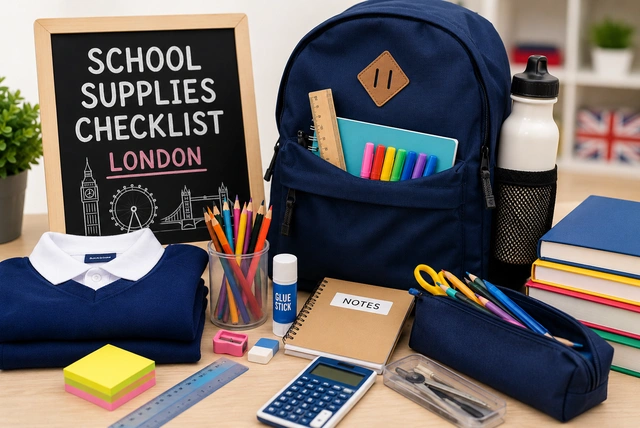
Every summer ends with the same little adventure in homes across London. One child proudly tries on a brand-new school jumper, another insists their old backpack is still “perfect,” while parents quietly wonder if they’ve remembered everything for the first day back. It starts with a simple shopping trip but often turns into a last-minute search for missing PE trainers, a scientific calculator, or that one notebook a teacher suddenly requests. If this sounds familiar, you’re certainly not alone.
A school supplies checklist London parents can trust should answer one question quickly: what does my child actually need, and what can I leave on the shelf? This guide does exactly that. It covers Nursery and Reception through to sixth form, and it adds the London details most national lists miss, including local shops, uniform grants, TfL travel cards and term dates.
Quick Answer: What School Supplies Does a Child Need in London?
- Reception and primary: book bag, water bottle, lunchbox, PE kit, name labels and a few basic pencil case items. Schools usually provide exercise books and most classroom stationery.
- Years 7 to 9: a stocked pencil case (2 blue or black pens, a green pen, pencil, ruler, rubber, sharpener), a scientific calculator, a geometry set, a water bottle, PE kit and a sturdy bag.
- GCSE and sixth form: everything above, plus highlighters, folders and dividers, a clear exam pencil case and any subject-specific kit.
- Budget: roughly £25 to £70 for a primary basket and £40 to £100 for a secondary basket, excluding uniform (indicative October 2026 estimates).
- Always check first: your school’s own equipment list overrides any general checklist, including this one.
We use five simple labels throughout the article so you can see at a glance what matters:
- Essential: almost always required or strongly expected.
- School usually provides: items you normally don’t need to buy.
- Optional: useful, but not required.
- Subject-specific: only needed for certain lessons or courses.
- Check school policy: items some schools restrict, such as gel pens, phones or branded bags.
If you’re already thinking ahead to your child’s future education, you may also enjoy reading our guide to London Business School, which explores one of the city’s most respected institutions for higher education.
Complete School Supplies Checklist by Age and Year Group
Requirements vary between London schools. A primary school in Richmond may supply most classroom stationery, while a secondary school in Camden or Croydon expects pupils to arrive with a fully stocked pencil case. Use the table below for a quick overview, then jump to your child’s year group.
| School stage | Main supplies | Special equipment | Check with school |
|---|---|---|---|
| Nursery and Reception | Book bag, water bottle, spare clothes, labels | Wellies, art apron (some schools) | Which classroom items are provided |
| Years 1 to 6 | Pencil case basics, ruler, reading folder, PE kit | Protractor in upper primary | Pen policy, bag size |
| Years 7 to 9 | Full pencil case, calculator, geometry set | Art and DT items | Exercise books, laptop, phone rules |
| Years 10 and 11 | As above, plus highlighters, folders, revision cards | Clear exam pencil case | Exam calculator rules |
| Years 12 and 13 | Ring binders, dividers, planner | Graphical calculator, art portfolio | Laptop or tablet policy |
Nursery and Reception School Supplies Checklist
Most London nurseries and Reception classes provide pencils, paper, crayons and art materials. Parents mainly supply personal items. This is the Reception school supplies list most schools expect:
- Named book bag or small backpack (Essential)
- Reusable water bottle (Essential)
- Spare change of clothes in a labelled bag (Essential at many schools)
- Name labels for every item of clothing and kit (Essential)
- PE bag and PE kit (if required)
- Lunchbox (for packed lunches)
- Wellington boots or art apron (school-specific)
- Pencil case, HB pencils, rubber, sharpener, glue stick, child-safe scissors and colouring pencils (Optional, only if requested)
School usually provides: most classroom stationery, paper and art materials. Don’t buy a big stationery set before the school confirms what it needs.
Year 1 and Year 2 Primary School Supplies Checklist
- School bag or book bag, water bottle, lunchbox (Essential)
- Reading folder or reading diary (Essential)
- PE kit and name labels (Essential)
- Pencil case with HB pencils, rubber, sharpener, 30 cm ruler (Optional, check school)
- Colouring pencils and glue stick (Optional)
Carry daily: book bag, reading folder, water bottle, lunchbox and coat. Leave at home: extra stationery, toys and anything valuable.
Year 3 to Year 6 Primary School Supplies Checklist
As children become more independent, schools ask them to look after their own pencil case. Some schools in Tower Hamlets, for example, provide a pencil case in Reception and Year 1 but ask pupils to bring their own pencil, ruler and handwriting pen by Year 5.
- Pencil case, HB pencils, rubber, sharpener, 30 cm ruler (Essential)
- Blue or black handwriting pen (only if the school allows pens)
- Colouring pencils or washable felt tips, glue stick (Optional)
- Protractor (upper Key Stage 2, if requested)
- Reading book and homework folder (Essential)
- Water bottle, lunchbox, PE kit and bag, name labels (Essential)
- Strong school bag (some schools ask for an expandable book bag, not a large backpack)
For more ideas on keeping young children’s belongings organised, you might like our guide to best baby products for new parents in London, which covers practical buying advice for younger families.
Year 7 to Year 9 Secondary School Supplies Checklist (Year 7 Equipment List London)
Starting secondary school is a big step. Different teachers, different rooms and a busier timetable mean pupils need to arrive prepared every day. Real London school lists show a clear pattern. For example, William Ellis School (Camden) and Forest Hill School (Lewisham) both ask Year 7 pupils for blue or black pens, a pencil, ruler, rubber, sharpener, calculator, protractor and a water bottle.
- Strong backpack with several compartments (Essential)
- Large pencil case (Essential)
- 2 blue or black pens (Essential)
- Green pen for marking your own work (Essential at some schools)
- HB pencil, rubber, sharpener, 30 cm ruler (Essential)
- Scientific calculator (Essential)
- Geometry set: compass, protractor, set squares (Essential)
- Colouring pencils, glue stick, highlighters (Optional)
- Ring binders, dividers, A4 refill pad (only if requested)
- Reusable water bottle (Essential; some schools ban glass)
- PE kit and bag, name labels (Essential)
- Art, DT or other kit (Subject-specific)
- Mobile phone, smart watch, gel pens, correction fluid (Check school policy; several London schools restrict or ban them)
School usually provides: exercise books. Laptops vary: at least one London secondary school asks Year 7 families to buy a laptop, while many others provide devices in class. Never buy a laptop until your school confirms.
Here is how the core Year 7 equipment breaks down, based on the 18 items in the checklist above.
Older students who are beginning to think about careers in science, engineering or digital technology may also enjoy reading our guide to future tech jobs in London, which shows how good study habits today can open exciting opportunities tomorrow.
Year 10 and Year 11 GCSE Equipment List
For GCSEs, add to the Year 7 to 9 list rather than starting again:
- Blue or black pens (buy a spare pack for exams)
- Pencils, rubber, sharpener, ruler
- Scientific calculator and geometry set
- Highlighters, revision cards and revision notebooks
- Subject folders, ring binders and dividers
- Clear plastic pencil case (exam requirement at many schools)
Calculator tip: exam rules come from the Joint Council for Qualifications (JCQ) and the exam boards, not from shops. Calculators with symbolic algebra or communication features are not allowed. The Casio fx-83GT CW and fx-85GT CW are widely used, but always confirm with your school’s maths department before buying.
Year 12 and Year 13 Sixth Form Supplies List
Sixth form study is more independent, so organisation matters more than extra gadgets.
- Functional bag, pencil case, black and blue pens, green pen, highlighters, ruler
- A4 ring binders, dividers, plastic wallets and refill pads
- Planner or diary
- Scientific or graphical calculator (Subject-specific, for example A-Level Maths)
- Laptop or tablet (usually recommended rather than compulsory)
- Art portfolio, sketchbook and brushes (Subject-specific)
Sixth formers heading to university can see how study life continues in our guide to student life at London City Institute of Technology, and the facilities and resources at London City Institute of Technology show how organised study spaces help students succeed.
School Uniform and PE Kit Checklist for London Students
Uniform is usually the biggest single cost, so treat it separately from stationery. From September 2026, state schools in England must keep compulsory branded uniform items to a minimum (the government limit is three branded items for most pupils, with a slightly higher allowance in secondary schools that require a tie). Schools should also offer second-hand uniform and avoid single-supplier deals. Read the official DfE school uniform guidance if your school’s price list seems high.
Everyday Uniform Essentials
- Shirts, blouses or polo shirts (buy at least two)
- Trousers, skirt, pinafore or shorts approved by the school
- Jumper, cardigan or blazer, and a tie if required
- Socks or tights, plus properly fitted black school shoes
- Waterproof winter coat
Comfortable shoes matter on a long London commute, so our guide to comfortable footwear for London walking is a useful read before you buy. According to Clarks’ back-to-school guide, checking uniform rules early and buying properly fitted shoes helps avoid unnecessary replacements.
PE Kit Checklist
- PE T-shirt and shorts or tracksuit bottoms (many primaries ask for a white top and black bottoms)
- Trainers or plimsolls and sports socks
- Sports jumper (if required) and PE bag
- Swimming costume and towel, football boots or other specialist footwear (only if requested)
Bags, Lunchboxes, Water Bottles and Labels
- Bags: a book bag suits Reception to Year 2. Older primary pupils need a bag that fits a reading book, folder and lunchbox. Secondary pupils need padded straps and several compartments. Some primaries ban large backpacks, so check first.
- Lunchboxes: choose leakproof boxes that your child can open alone. Many London schools are nut-free, so follow your school’s allergy policy.
- Water bottles: a named, spill-proof bottle. A few schools do not allow glass.
- Labels: iron-on, sew-in or stick-on labels all work. Label jumpers, PE kit, bottles and lunchboxes, because these fill school lost property every term.
What Do London Schools Provide and What Must Parents Buy?
This is the section that saves the most money. Schools set their own rules, so there is no single London-wide policy. The pattern below comes from real school lists, including William Ellis (Camden), Forest Hill (Lewisham), Fortismere (Haringey) and several Hackney and Barnet primaries.
| Usually provided by the school | Usually bought by parents | Varies by school |
|---|---|---|
| Exercise books | School bag | Laptop or tablet |
| Textbooks | Pencil case and personal stationery | Calculator (some sell them) |
| Classroom stationery in primary | Water bottle and lunchbox | Geometry set |
| Classroom art materials | Uniform and PE kit | Highlighters, glue sticks |
| Lab and specialist equipment | Name labels | Planner or diary |
Questions to Ask Before You Shop
- Does the school provide exercise books?
- Which calculator model, if any, does the maths department recommend?
- Is a laptop or tablet compulsory?
- Are gel pens, correction fluid, phones or branded bags banned?
- Does the school use a named uniform supplier, and are second-hand items available?
According to Ryman’s Back-to-School Checklist, parents should focus on the essentials first and only buy extras that appear on the school’s recommended equipment list.
How Much Do School Supplies Cost in London?
Costs rise with age because secondary pupils need a calculator, geometry set, folders and a bigger bag. National surveys from 2025 and 2026 put overall back-to-school spending, including uniform, at roughly £100 to £300 or more per child, with uniform the largest item. Public surveys rarely split London from the rest of the UK, so treat London prices as similar to national ones, with some extra cost at independent uniform suppliers.
The figures below are indicative October 2026 estimates for stationery, bag and kit, excluding uniform. Check live prices before buying.
| Basket type | Primary | Secondary |
|---|---|---|
| Cheap (supermarket or discount) | £25 to £40 | £40 to £60 |
| Mid-range (high street) | £50 to £70 | £70 to £100 |
| Premium (branded bag and stationery) | Higher | Often over £100 |
Hidden Costs Parents Often Forget
- Replacing lost water bottles, jumpers and pens
- Shoes and uniform when children grow mid-year
- School trips and printing or revision materials
- A laptop, tablet or headphones, if your school requires them
- Subject kit for art, DT or food technology
If your school asks for a laptop or headphones, our roundup of the latest electronics deals in London can help you compare prices before you buy.
According to Education Buying, planning purchases in advance, reusing quality supplies and buying only school-approved equipment are among the most effective ways to control costs.
Where to Buy Cheap School Supplies in London
| Where | Best for | Good to know |
|---|---|---|
| Supermarkets (Tesco, Asda, Sainsbury’s) | Lowest-price pens, pencils, bags and lunchboxes | Often the cheapest basic stationery |
| Primark | Low-cost bags and basic items | Limited stationery range |
| The Works | Budget stationery bundles | Click and collect available |
| Ryman and WHSmith | Calculators, geometry sets, exam kits | Branches across London and at stations |
| Argos | Calculator and maths set bundles | Click and collect in London stores |
| Amazon UK | Multipacks and quick delivery | Check pack sizes before comparing prices |
For specialist or higher-quality items, London has many independent shops. Art and graphic suppliers such as London Graphic Centre and Cass Art suit older students taking art or design. Areas such as Covent Garden, Bloomsbury and Shoreditch have independent stationers, and a local print shop like Printbox London in Tottenham stocks labels and stationery. Our guide to the best stationery stores in London lists more options by area.
Simple Ways to Spend Less
- Check last year’s backpack, ruler, calculator and geometry set before buying new ones.
- Buy stationery bundles and supermarket own-brand packs.
- Spend more on items that last, such as shoes, bags and calculators.
- Divide your list into essential, recommended and optional, and buy the essentials first.
- Ask your school about second-hand uniform sales.
Stocking the lunchbox is part of the weekly budget too, and our guide to the best grocery stores in London can help you find good-value options near you.
Free School Supplies and Financial Help for London Parents
School Uniform Grants in London Boroughs
Some London councils offer a school clothing grant, but there is no single London-wide scheme. Amounts, eligibility and deadlines differ by borough, and some deadlines fall in the autumn, so check early. Tower Hamlets, for example, has reported grants of £50 for primary and £150 for secondary pupils for 2026/27. Several other boroughs run schemes too, while some, such as Richmond, no longer offer one.
| Borough | Uniform grant status (as reported, 2026/27) | Action |
|---|---|---|
| Tower Hamlets | Reported £50 primary, £150 secondary, income-tested | Check eligibility and deadline on the council site |
| Brent, Greenwich, Hackney, Islington, Haringey, City of London | Schemes reported; amounts roughly £50 to £160, often linked to free school meals or income | Confirm on your borough page |
| Richmond | Reported as no longer offered | Ask your school about its hardship fund |
| Southwark, Lambeth and others | Varies | Search “[your borough] school clothing grant” |
Grant details change each year. Always confirm amounts, eligibility and deadlines with your local council before applying.
Free School Meals and Other Support
- Free school meals: free school meals are means-tested, and eligibility rules have been widening, so apply through your council even if you are unsure. Some London boroughs and the Mayor of London’s schemes also fund meals for all primary pupils, which is separate from means-tested support.
- School hardship funds: many schools use Pupil Premium or hardship funding to help with kit, trips and equipment. Ask the school office privately.
- Second-hand uniform: school uniform banks, swap shops and PTA sales are encouraged by government guidance.
- Charities: organisations such as Child Poverty Action Group offer advice on benefits and local help.
School Supplies for Children with SEN and Additional Needs
Not every child needs specialist items, and a school’s SENCO should guide what is useful. These options are commonly suggested:
- Dyslexia: tinted reading overlays, clearly organised folders and easy-grip pens (where the school agrees).
- Autism and sensory needs: visual planners, simple organised pencil cases and, where approved in an EHCP or by the school, ear defenders.
- Left-handed pupils: left-handed scissors, ergonomic pencil grips and notebooks that don’t smudge.
Safe, Eco-Friendly and Allergy-Aware School Supplies
- Safety: look for UKCA or CE marking on children’s products, age-appropriate scissors and small-parts warnings for younger children.
- Eco options: recycled notebooks, refillable pens, reusable lunch bags and durable bags that last several years. Be cautious about “eco” claims without a recognised certification.
- Allergies: many London schools are nut-free. Choose leakproof, easy-to-clean containers and follow your school’s food policy.
London School Term Dates and the Best Time to Buy
Term dates differ between boroughs and academy trusts, and INSET days are set by each school, so always check your school’s calendar. For 2026/27, most London schools start in the first days of September 2026, with half-terms in late October, mid-February and late May, and the summer term ending in late July 2027.
| When | What to do |
|---|---|
| Early summer | Read your school’s equipment list and check what you already own |
| Summer sales | Compare prices and buy bags, calculators and shoes |
| Mid to late August | Finish the main shopping and label everything |
| September | Buy anything the teachers add |
| January | Replace lost or broken items |
Shops are busiest in the last week of the summer holidays, so shopping a few weeks early gives you more choice.
TfL Travel Cards and School Journeys in London
| Age | What you get | Photocard fee |
|---|---|---|
| Under 5 | Free on TfL services with an accompanying adult | None |
| 5 to 10 | Free on buses and trams; free on Tube, DLR, Overground and Elizabeth line with a 5-10 Zip photocard or when with an adult | About £11.50 |
| 11 to 15 | 11-15 Zip Oyster photocard: free buses and trams, child-rate fares on rail | £16.50 |
| 16 to 17 | 16+ Zip Oyster photocard: free buses and trams for London residents | £22 |
Children moving from Year 6 to Year 7 often need a new 11-15 photocard, which requires a digital photo and proof of age, so apply well before September. Apply and check the latest fees on the official TfL 11-15 Zip Oyster photocard page. For weekend plans once term is under way, see our guide to family attractions in London.
Daily journey pack-up: school bag, Zip card, water bottle, lunchbox and a waterproof coat.
Simple Habits That Help Students Stay Organised All Year
- Pack the bag the evening before, using the timetable.
- Do a ten-minute weekend check: empty old worksheets, sharpen pencils, refill the pencil case and wash the bottle.
- Keep spare pens, pencils and chargers in one homework spot at home.
- Let children pack and tick off their own bag as they grow older.
According to Save My Exams, preparing school bags the evening before and keeping a steady study routine helps students focus on learning instead of forgotten equipment.
Printable School Supplies Checklist London
Copy this into a note or print the page. Tick each item as you buy it, and add anything your school specifically requests.
| Section | Tick-off items |
|---|---|
| Reception and primary | ☐ Book bag ☐ Water bottle ☐ Lunchbox ☐ PE kit ☐ Labels ☐ Reading folder ☐ Pencil case basics |
| Secondary | ☐ Backpack ☐ Pencil case ☐ 2 pens ☐ Green pen ☐ Ruler ☐ Calculator ☐ Geometry set |
| GCSE | ☐ Spare pens ☐ Highlighters ☐ Revision cards ☐ Folders ☐ Clear pencil case |
| Sixth form | ☐ Ring binders ☐ Dividers ☐ Planner ☐ Laptop or tablet (if required) |
| Uniform and PE | ☐ Shirts ☐ Trousers or skirt ☐ Jumper or blazer ☐ Shoes ☐ Coat ☐ PE kit |
| School-specific | ☐ _______________ ☐ _______________ ☐ _______________ |
Final Thoughts on Your School Supplies Checklist London
A new school year is more than buying stationery or replacing school shoes. It is a fresh start with new teachers, new friends and new chances to learn. Check your school’s official list first, buy the essentials, reuse what still works and compare prices before you spend. Look into your borough’s grants and school term dates early, and sort travel cards well before September. Every child and every school is different, so use this guide as your starting point. We hope this guide from The London Report helps your family enjoy a confident, organised and successful return to school.
Frequently Asked Questions
What school supplies does a child need in London?
Most children need a school bag, water bottle, lunchbox, PE kit, uniform and name labels. Primary pupils add a few pencil case basics, and secondary pupils add pens, a ruler, a scientific calculator and a geometry set. Always check your school’s own list.
Do London primary schools provide stationery?
Many do. Most provide exercise books, pencils and classroom resources, but parents usually buy the bag, water bottle, lunchbox, PE kit and labelled clothing. Policies differ by school.
What stationery does a secondary school student need?
Typically blue or black pens, a green pen, pencil, rubber, sharpener, 30 cm ruler, scientific calculator, geometry set and a water bottle. Some schools also ask for highlighters, folders or a planner.
What equipment does a Year 7 student need?
A strong bag, a full pencil case, a calculator, a geometry set, a water bottle, PE kit and labelled uniform. Some schools also require a laptop, so confirm before buying one.
What calculator is needed for GCSE Maths?
A standard scientific calculator that meets JCQ exam rules is needed, and models such as the Casio fx-83GT CW and fx-85GT CW are widely used. Ask your maths department to confirm the exact model.
How much does back-to-school shopping cost in London?
Indicatively, £25 to £70 for primary and £40 to £100 for secondary, excluding uniform. Uniform and shoes can cost far more, so reuse and compare prices where you can.
Where can I buy cheap school supplies in London?
Supermarkets, The Works and Primark are usually cheapest for basics. Ryman, WHSmith and Argos suit calculators and exam kits, and online stores help you compare multipacks.
Are school uniform grants available in London?
Some boroughs offer them and some do not. Eligibility, amounts and deadlines vary, so check your local council’s website early.
What should I pack in my child’s school bag every day?
A stocked pencil case, planner or reading book, the right books for the timetable, a water bottle, lunch if needed, any PE kit, a travel card and a waterproof coat.
When should parents buy school supplies in London?
Start planning in early summer, compare prices in the summer sales and finish the main shopping by mid to late August. Top up in September and January.