
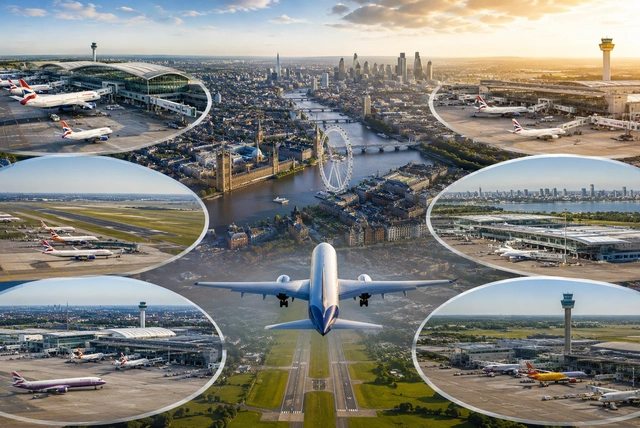
London has six major commercial passenger airports: Heathrow (LHR), Gatwick (LGW), Stansted (STN), Luton (LTN), London City (LCY) and Southend (SEN). Only Heathrow and London City sit inside Greater London, but all six are counted as London airports.
Some websites give a different number because they also count private or military airfields. This guide explains why, compares the six airports using the latest Civil Aviation Authority (CAA) passenger data, and helps you choose the right one for your trip.
How Many Airports Are in London in 2026?
The standard answer is six. The Greater London Authority describes these six as London’s major international airports, and the CAA groups the same six in its London Area Airports statistics.
Two of them are inside the Greater London boundary: Heathrow in Hillingdon and London City in Newham. The other four are outside it. Gatwick is in West Sussex, Stansted and Southend are in Essex, and Luton is in Bedfordshire. They still count as London airports because they carry the London name, serve London travellers and are reported together in official figures.
Why do some websites give a different number?
The total changes with the definition used. Here is how the common counts add up.
| Number | What is being counted |
|---|---|
| 2 | Only the commercial airports inside Greater London: Heathrow and London City |
| 5 | The six minus Southend, which is the smallest and is often left out |
| 6 | All scheduled passenger airports: Heathrow, Gatwick, Stansted, Luton, London City and Southend (the standard answer) |
| 8 or more | The six plus business and military airfields, such as Biggin Hill, Farnborough and RAF Northolt |
Southend is small but open. It handled 719,513 terminal passengers in 2025, up from 287,758 in 2024, so articles that call it closed or unimportant are out of date.
London Airports List: Names, Codes and Locations
Here are the six airports at a glance. Distances are approximate straight-line distances from Charing Cross in central London, so the real journey by road or rail is longer.
| Airport | Code | Location | Inside Greater London? | Distance from centre | Main rail link |
|---|---|---|---|---|---|
| Heathrow | LHR | Hillingdon, west London | Yes | About 14 miles | Heathrow Express, Elizabeth line, Piccadilly line |
| Gatwick | LGW | Crawley, West Sussex | No | About 25 miles | Gatwick Express, Southern, Thameslink |
| Stansted | STN | Essex, north-east of London | No | About 30 miles | Stansted Express |
| Luton | LTN | Bedfordshire, north of London | No | About 27 miles | Train from Luton Airport Parkway, then the DART shuttle |
| London City | LCY | Newham, east London | Yes | About 8 miles | Docklands Light Railway (DLR) |
| Southend | SEN | Southend-on-Sea, Essex | No | About 35 miles | Greater Anglia trains |
London Airports Map
The airports sit around the capital like points on a compass. Heathrow is to the west, Gatwick to the south, London City to the east, Luton and Stansted to the north, and Southend further out on the Essex coast. Biggin Hill, shown in grey, is inside Greater London but handles private flights only.
Which Is the Biggest and Busiest Airport in London?
Heathrow is both the biggest and the busiest. It handled 84,481,178 terminal passengers in 2025. That is about 47% of the 179.2 million passengers across the six airports. Gatwick came second with 42.8 million.
The top two barely changed in 2025. Heathrow grew by about 1% and Gatwick fell by about 1%. The bigger moves were further down: Luton and London City each grew by about 5%, and Southend grew by 150% from a very low base.
The Six London Airports Explained
Heathrow (LHR)
Heathrow is London’s main gateway for long-haul travel. It has four passenger terminals (2, 3, 4 and 5), two runways and flights to every major region. It suits you best if you want a long-haul flight, a connection or a full-service airline. If you land late or leave early, our guide to hotels near Heathrow Airport can save you a long night transfer.
Gatwick (LGW)
Gatwick is the UK’s second-busiest airport. It has a North and a South terminal, one main runway and a mix of European, holiday and some long-haul routes. Gatwick Express takes about 30 minutes to Victoria. It works well for holidays and for travellers staying in south London or Sussex.
Stansted (STN)
Stansted has one main terminal and focuses on low-cost flights to Europe. Stansted Express runs direct to Liverpool Street. It is a good choice for budget city breaks, especially if you are staying in north-east London.
Luton (LTN)
Luton has one terminal and a strong low-cost network, mainly to European destinations. The station, Luton Airport Parkway, is not at the terminal, so you need the DART shuttle as well. That adds a little time and cost, but Luton is handy for north London.
London City (LCY)
London City is the closest airport to central London, in the Royal Docks. It has one terminal, short-haul and business routes, and a direct DLR link to Canary Wharf and Bank. Its aircraft and route network are limited, so it is rarely the right choice for long-haul trips. It is ideal for meetings in the City or Canary Wharf.
Southend (SEN)
Southend is the smallest of the six, with one terminal and a narrower route list. Greater Anglia trains run to Liverpool Street and Stratford, and the station is close to the terminal. It suits travellers in south Essex or east London when a flight fits their plans.
How to Get From Each London Airport to Central London
Every airport has a direct rail or light rail link. The fastest options are shown below, shortest first.
| Airport | Fastest option | Typical time | Other options |
|---|---|---|---|
| Heathrow | Heathrow Express to Paddington | 15 minutes | Elizabeth line (about 28 minutes to Paddington) and Piccadilly line (about 50 minutes) |
| London City | DLR | 18 minutes to Canary Wharf, 22 minutes to Bank | Local buses |
| Gatwick | Gatwick Express to Victoria | 30 minutes | Southern and Thameslink trains to Victoria, London Bridge and St Pancras |
| Luton | Train to St Pancras, plus DART shuttle | About 40 minutes | Coaches |
| Stansted | Stansted Express to Liverpool Street | About 47 minutes | Coaches |
| Southend | Greater Anglia to Liverpool Street | About 55 minutes | Trains to Stratford |
Fares change, so check before you travel. At the time of research, Heathrow listed the Heathrow Express from £10 when booked in advance, the Elizabeth line from £13.90 to or from Zone 1, and the Piccadilly line from £5.90 off-peak. You can pay by contactless or Oyster on the Tube and Elizabeth line to Heathrow, on the DLR at London City, and on Gatwick Express, Southern and Thameslink services at Gatwick. Check live times and prices with Transport for London and National Rail.
Landing late or flying early? Check the first and last trains before you book, because some services run less often at night. Heathrow also publishes overnight bus information on its website. For a short stay close to the terminal, compare our list of airport hotels in London or look at cubicle hotels in London for a low-cost option.
Which London Airport Should You Choose?
There is no single best airport. Choose by route, where you are staying and the total cost, including the transfer.
| If you want… | Choose | Why |
|---|---|---|
| Long-haul flights and global connections | Heathrow | Widest network and fast rail links |
| Holiday flights and a broad network | Gatwick | Mix of leisure, European and some long-haul routes |
| Cheap flights to Europe | Stansted or Luton | Both are busy bases for low-cost airlines |
| Business in the City or Canary Wharf | London City | Closest airport, direct DLR |
| A flight from Essex or east London | Southend | Smaller and quieter, if your route is offered |
| A private jet | Biggin Hill or Farnborough | Business aviation airports |
Heathrow or Gatwick?
Pick Heathrow for long-haul flights and the fastest rail links. Pick Gatwick for holiday routes and for travel to south London and Sussex. Compare the full cost, including the transfer, not just the flight price. Our guide to the best airport in London goes into more detail.
Stansted or Luton?
Both focus on low-cost airlines. Stansted has a direct express train to Liverpool Street. Luton needs a train and a shuttle, but it can be closer to north London. Check your exact route, because the cheaper flight can cost more once you add transport.
London City or Southend?
London City is far more convenient for central London, but its routes are mostly short-haul. Southend suits travellers in Essex when a flight fits. For a wider side-by-side view of all six, see this London airport comparison.
Are There Other Airports in London?
Yes, but they are not part of the six because they do not run scheduled passenger flights. If none of the six suits your route, you can also look at other airports near London.
- Biggin Hill (BQH): in Bromley, inside Greater London. It calls itself the only dedicated business aviation airport in London and serves private jets.
- Farnborough (FAB): in Hampshire, outside Greater London. It handles business aviation only.
- RAF Northolt (NHT): in Hillingdon. It is an active Royal Air Force station, and civil flights are limited. It is not a normal public airport.
London Heliport and smaller airfields are separate again and are also left out of the count.
Quick Tips Before You Book
- Add the transfer cost to the flight price before you decide which airport is cheaper.
- Check the first and last trains for your flight time.
- Check your terminal, check-in time and baggage rules on the airport website.
- If you need help with mobility, contact the airport or your airline before you travel.
The Short Answer
London has six major commercial airports: Heathrow, Gatwick, Stansted, Luton, London City and Southend. Business and military airfields such as Biggin Hill and RAF Northolt are counted separately. Once you land, our guide to things to do in London can help you plan your days, and if you are travelling in summer it is worth checking the London weather in June. If you are flying in to study, this look at student life at London City Institute of Technology shows what to expect, and if you arrive hungry, food trucks in London are a quick way to try local and international street food.
Frequently Asked Questions About London Airports
How many airports are in London?
London has six major commercial passenger airports: Heathrow, Gatwick, Stansted, Luton, London City and Southend. Business and military airfields are not included in this count.
What are the six airports in London?
They are Heathrow (LHR), Gatwick (LGW), Stansted (STN), Luton (LTN), London City (LCY) and Southend (SEN).
How many international airports does London have?
All six are described as major international airports by the Greater London Authority. The routes each one offers vary by airline and season.
Which London airport is closest to central London?
London City Airport is the closest, about 8 miles in a straight line from Charing Cross. The DLR reaches Canary Wharf in 18 minutes and Bank in 22 minutes.
What is the biggest airport in London?
Heathrow. It handled 84,481,178 terminal passengers in 2025, about 47% of the total for London’s six major airports.
Is Southend still a London airport?
Yes. Southend is part of the official six-airport group. It is the smallest, with 719,513 terminal passengers in 2025, but it is open and growing.
Is Biggin Hill a commercial airport?
No. Biggin Hill is in Bromley and mainly serves private jets and business aviation, not scheduled passenger flights.
Is RAF Northolt open to the public?
No. It is an active RAF station. Civil flights are limited and can be displaced by military or government movements.
Are all six London airports inside Greater London?
No. Only Heathrow and London City are inside Greater London. Gatwick, Stansted, Luton and Southend are outside it.
Which London airport is best for budget airlines?
Stansted and Luton are the main low-cost bases, and Gatwick is also worth comparing. The cheapest option depends on your route, so add the transfer cost to the fare.
Sources and data notes: passenger figures are CAA terminal passenger totals for the full years 2024 and 2025. Airport locations follow the Greater London Authority. Transport times come from TfL, Heathrow and Gatwick. Biggin Hill details come from London Biggin Hill Airport. Fares and timetables change, so always check the operator before you travel.