


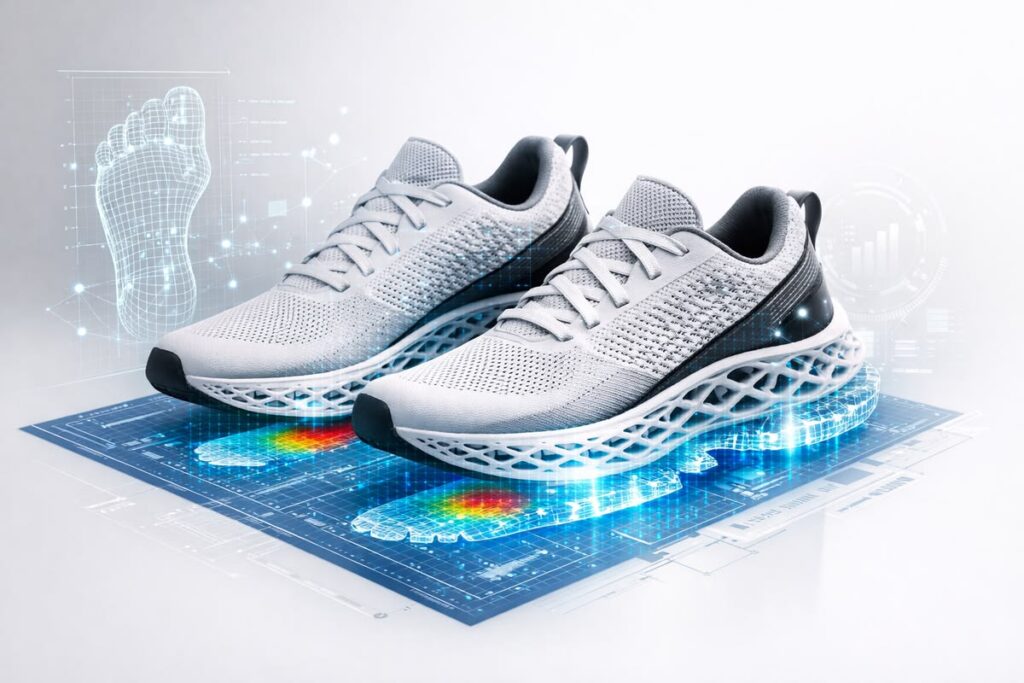
More than 70% of people wear shoes that don’t truly fit, and footwear waste accounts for hundreds of millions of discarded pairs every year. Traditional shoe design relies on averages, not real human feet—resulting in discomfort, excess inventory, and unnecessary waste. AI shoes are emerging as a solution. By combining artificial intelligence, precise foot scanning, and 3D printing, footwear can now be designed for individual bodies and produced on demand. This shift promises better fit, improved comfort, and a more sustainable future for how shoes are designed, made, and worn.
What Are AI Shoes?
AI shoes are footwear created using artificial intelligence across design, fit, and manufacturing. Unlike traditional shoes that rely on fixed molds and standard sizing, AI shoes use real user data to generate footwear tailored to individual feet and movement patterns.
AI shoes typically involve:
- Artificial intelligence–driven shoe design
- High-resolution foot scanning and data analysis
- Algorithm-optimized structures
- On-demand 3D printing
- Personalized fit for each foot
Rather than forcing people to adapt to shoes, AI shoes adapt to the person wearing them.
Read Also: Advantages of Internet of Things (IoT): Benefits, Examples & Future Impact
Why Traditional Footwear Models Are Being Challenged
Traditional footwear manufacturing has long prioritized scale and efficiency over individuality. Limited size ranges and standardized shapes are used to serve millions of people, even though no two feet are truly the same.
This model often results in:
- Poor fit and discomfort
- Pressure points and imbalance
- Excess inventory and material waste
- Limited personalization
AI shoes challenge this approach by using real biometric data and intelligent design, making footwear more comfortable, efficient, and sustainable.
How Artificial Intelligence Is Transforming Shoe Design
Artificial intelligence plays a critical role long before a shoe is produced.
Modern AI design systems can:
- Generate original shoe silhouettes
- Optimize structures for comfort, airflow, and durability
- Simulate pressure distribution before manufacturing
- Automate complex design calculations
- Explore thousands of design variations quickly
Designers remain essential, but their role has shifted. Instead of manually refining every technical detail, they focus on creative direction while AI handles optimization and precision.
Foot Scanning: Designing Shoes From Real Data
Foot scanning is a foundational technology behind AI shoes.
Using precision scans, AI systems analyze:
- Foot length, width, and volume
- Arch height and curvature
- Pressure zones during movement
- Gait and balance patterns
- Differences between left and right feet
This data allows each shoe to be designed independently, improving comfort, alignment, and long-term wearability.
3D Printing: From Digital Design to Physical Shoe
Once an AI design is finalized, 3D printing transforms the digital model into a physical product.
Compared to traditional manufacturing, 3D printing offers:
- On-demand production without molds
- Complex lattice structures for cushioning and airflow
- Reduced material waste
- Faster iteration and customization
Advanced lattice soles adapt to pressure zones and movement, creating footwear that feels responsive rather than rigid.
Types of AI Shoes Available Today
AI technology is applied to footwear in several distinct ways:
1. Custom Fit AI + 3D-Printed Shoes
Fully personalized shoes designed from detailed foot scans and produced on demand. Each shoe is tailored to the individual foot.
2. AI-Designed Performance and Recovery Shoes
Footwear optimized by AI for movement efficiency, impact reduction, and recovery, often using adaptive structures.
3. AI-Generated Shoe Design Concepts
AI systems create original shoe designs based on style inputs, materials, and trends, supporting designers and brands during ideation.
4. AI Virtual Try-On Shoes
Digital visualization tools that allow users to preview how shoes will look on models or their own images before purchasing.
5. Hybrid AI Footwear
Shoes that combine traditional manufacturing with AI-optimized components, such as 3D-printed midsoles or algorithm-designed structures.
How Much Do AI Shoes Cost?
AI shoes typically cost more than mass-produced footwear due to customization and advanced manufacturing. However, pricing reflects improved fit, reduced waste, and higher performance.
Typical AI Shoe Price Ranges
| Type of AI Shoes | Approximate Price Range |
|---|---|
| Custom AI + 3D-Printed Shoes | $130 – $200+ |
| AI-Designed Performance Footwear | $150 – $280+ |
| Hybrid AI / 3D-Printed Shoes | $160 – $230 |
| AI Virtual Try-On Footwear | Free to subscription-based |
| AI Shoe Design Tools (Concept Only) | Free to paid plans |
Prices vary based on materials, customization depth, and production complexity.
Read More: Prime Technology Ltd: Computers, Accessories & Reliable Tech Support
Performance, Comfort, and Everyday Wear
AI shoes are not just about personalization. Many are designed to improve how people move throughout the day.
Common benefits include:
- Pressure-responsive cushioning
- Improved balance and support
- Reduced joint stress
- Enhanced airflow and breathability
- Greater comfort during extended wear
By responding intelligently to pressure and movement, AI shoes aim to reduce fatigue and improve overall comfort.
Creators, Independent Brands, and the New Footwear Economy
AI shoes are also changing who gets to design and sell footwear.
AI design platforms and on-demand manufacturing enable:
- Independent designers to launch without factories
- Creators to sell custom footwear directly to audiences
- Limited-edition and made-to-order releases
- Lower financial risk for new brands
Footwear is shifting from mass retail toward personal expression and direct-to-consumer models.
AI Shoes vs Traditional Shoes
| Feature | AI Shoes | Traditional Shoes |
|---|---|---|
| Fit | Scan-based and personalized | Standard sizing |
| Design | AI-optimized | Manual |
| Manufacturing | On-demand | Mass production |
| Comfort | Pressure-adaptive | Fixed |
| Waste | Low | High |
Traditional footwear remains common, but AI shoes raise the standard for fit and efficiency.
Challenges and Limitations
Despite rapid progress, AI shoes still face challenges:
- Higher upfront costs
- Longer production time than off-the-shelf shoes
- Limited material options in some designs
- Dependence on accurate scanning
As adoption grows and technology matures, these limitations are expected to continue decreasing.
The Future of AI Shoes
AI shoes are moving toward:
- Faster scan-to-print timelines
- Fully automated design pipelines
- Personalized footwear for sports, recovery, and medical use
- Broader material options and sustainability improvements
- Seamless digital-to-physical fashion experiences
Footwear is evolving from a static product into an intelligent, responsive system.
Conclusion
AI shoes represent a major shift in how footwear is designed, manufactured, and experienced. By combining artificial intelligence, precision foot scanning, and 3D printing, shoes are becoming more personal, more comfortable, and more efficient to produce.
This transformation is not just about technology. It is about designing footwear that works with the human body instead of forcing the body to adapt. As AI continues to advance, AI shoes are redefining expectations for comfort, performance, and sustainability across the footwear industry.
Frequently Asked Questions (FAQs)
What are AI shoes?
AI shoes are footwear designed using artificial intelligence, often combined with foot scanning and 3D printing for personalized fit.
Are AI shoes custom-made?
Many AI shoes are created using scans of individual feet, allowing customized design.
How much do AI shoes cost?
Most AI shoes range from $130 to $280 or more, depending on customization and materials.
Are AI shoes suitable for everyday use?
Yes, many are designed for daily wear with enhanced comfort and support.
Are AI shoes the future of footwear?
AI shoes are widely seen as a key direction for the future of footwear design and manufacturing.
Trusted Sources & References
- McKinsey & Company : Global management consulting firm providing research on footwear manufacturing, customization, AI adoption, and advanced production systems.
- MIT Media Lab : Academic research leader in generative design, AI-driven manufacturing, and computational design used across industries including footwear.
- Journal of Foot and Ankle Research : Peer-reviewed scientific journal covering foot structure, biomechanics, asymmetry, pressure distribution, and fit-related studies.
- Footwear News (FN) : Leading global trade publication for the footwear industry, covering innovation, AI, 3D printing, and manufacturing trends.
- 3Dnatives : International reference platform for additive manufacturing, with in-depth reporting on 3D-printed footwear and industrial use cases.