


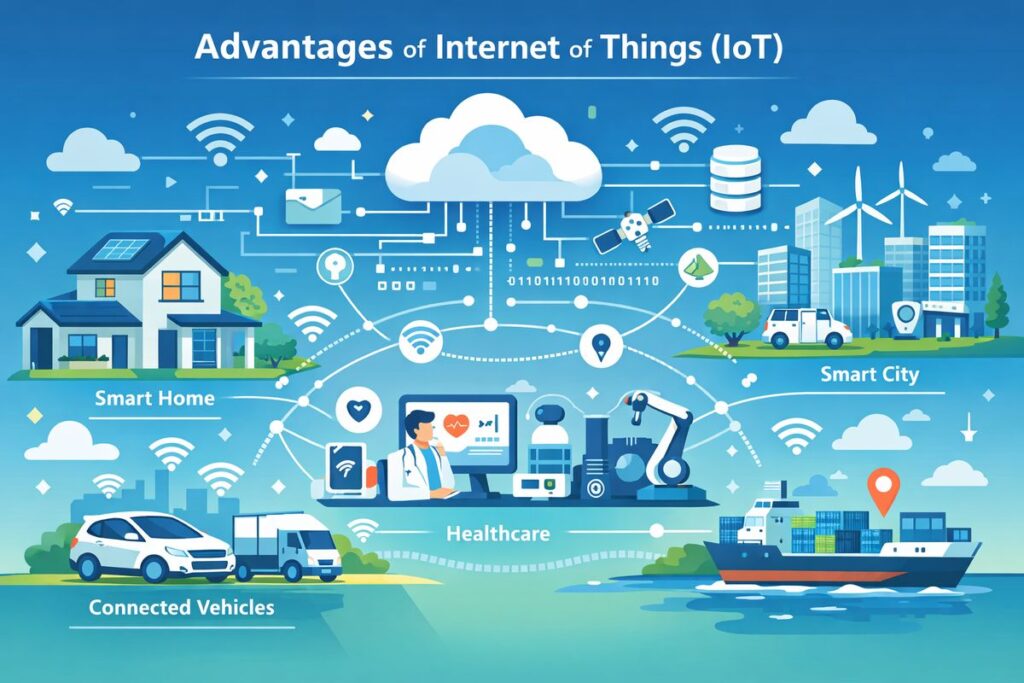
Imagine a world where everyday objects think, communicate, and act intelligently. This is no longer futuristic—according to industry estimates, over 15 billion devices are already connected through the Internet of Things (IoT), and this number is expected to double within this decade. However, managing efficiency, cost, safety, and data across industries remains a major challenge. This is where IoT becomes critical. In this article, you’ll discover the key advantages of Internet of Things (IoT), real-world examples, and how IoT is transforming industries, businesses, and daily life through automation, real-time insights, and smarter decision-making.
What Is the Internet of Things (IoT)?
The Internet of Things (IoT) refers to a network of physical objects embedded with sensors, software, and connectivity that allow them to collect, transmit, and act on data without continuous human intervention.
Unlike traditional internet usage that focuses on computers and smartphones, IoT extends connectivity to everyday objects such as appliances, vehicles, wearables, machines, and infrastructure. These connected devices can be monitored and controlled remotely, making systems smarter, faster, and more efficient.
Why Is IoT Important?
IoT is important because it bridges the gap between the physical and digital worlds. It enables systems to respond to real-world conditions using data instead of assumptions.
Key reasons why IoT matters:
- Growing demand for automation and efficiency
- Need for real-time monitoring and control
- Data-driven decision-making
- Increasing complexity in industries and cities
Today, IoT is not optional—it is becoming a core foundation of digital transformation.
Read Also: Apple TV Outage: Is Apple TV Down Today? Latest Status, Causes, and Fixes
Major Advantages of Internet of Things (IoT)
Below are the most important advantages of IoT, explained clearly with real-world relevance.
1. Automation and Reduced Human Effort
One of the biggest advantages of Internet of Things is automation. IoT devices communicate with each other and perform tasks automatically based on data and predefined rules.
Examples include:
- Smart lights turning off automatically
- Automated production lines in factories
- Smart irrigation systems adjusting water usage
Automation reduces manual effort, errors, and operational costs.
2. Real-Time Data Collection and Monitoring
IoT devices continuously collect real-time data from their surroundings. This allows users and organizations to monitor conditions remotely and take immediate action when required.
Use cases:
- Monitoring patient health
- Tracking machine performance
- Observing traffic and environmental conditions
Real-time insights lead to faster and more accurate decisions.
3. Improved Efficiency and Productivity
IoT optimizes workflows and minimizes delays by enabling machines and systems to operate intelligently. Automated processes are faster, more consistent, and less prone to human error.
Industries such as manufacturing, logistics, agriculture, and retail use IoT to increase productivity while reducing resource consumption.
4. Cost Savings and Resource Optimization
IoT helps reduce unnecessary expenses by identifying inefficiencies and preventing failures before they occur.
Examples:
- Predictive maintenance reduces repair costs
- Smart energy systems lower electricity bills
- Optimized inventory management reduces waste
Over time, IoT delivers significant financial benefits.
5. Enhanced Safety and Security
IoT improves safety by detecting risks early and issuing alerts in real time.
Examples include:
- Fire and gas leak detection sensors
- Smart surveillance and alarm systems
- Accident detection in vehicles
These systems help prevent accidents and enable faster emergency responses.
6. Better Healthcare and Remote Patient Monitoring
In healthcare, IoT enables continuous monitoring of patients through wearable and medical devices. Doctors receive real-time health data, allowing early diagnosis and evidence-based treatment.
This improves patient outcomes and reduces unnecessary hospital visits, especially for chronic conditions.
7. Smarter Cities and Infrastructure
IoT plays a key role in developing smart cities by connecting traffic systems, utilities, waste management, and public services.
Benefits include:
- Reduced traffic congestion
- Efficient energy and water usage
- Improved urban planning
- Cleaner and safer environments
8. Improved Customer Experience
IoT enables personalized and seamless experiences by analyzing user behavior and preferences.
Examples:
- Real-time delivery tracking
- Smart retail recommendations
- Connected customer support systems
This improves satisfaction and builds long-term trust.
Advantages of Internet of Things with Examples
| Advantage | Description | Example |
|---|---|---|
| Automation | Tasks performed automatically | Smart home systems |
| Real-time monitoring | Instant data access | Health monitoring wearables |
| Cost reduction | Lower operational expenses | Predictive maintenance |
| Safety improvement | Early hazard detection | Fire and gas sensors |
| Productivity | Faster, accurate operations | Industrial automation |
| Smart infrastructure | Efficient city management | Smart traffic lights |
Real-Life Applications of IoT
IoT is already deeply integrated into everyday life and industries:
- Smart homes and appliances
- Wearable fitness and health devices
- Industrial automation and smart factories
- Connected vehicles and transportation
- Smart agriculture and precision farming
- Smart cities and utilities
These applications demonstrate the practical value of IoT across sectors.
Future Impact of Internet of Things
The future of IoT is closely connected with Artificial Intelligence (AI), 5G networks, and edge computing. These technologies will make IoT systems faster, more intelligent, and more secure.
Future developments include:
- Autonomous vehicles
- AI-powered healthcare monitoring
- Fully automated warehouses
- Climate and environmental monitoring
As the number of connected devices continues to grow, IoT will remain a key driver of digital innovation.
Read Also: Prime Technology Ltd: Computers, Accessories & Reliable Tech Support
Conclusion
The advantages of Internet of Things (IoT) clearly highlight its importance in the modern digital era. By enabling automation, real-time data exchange, improved efficiency, enhanced safety, and smarter decision-making, IoT is transforming industries and improving everyday life.
While challenges such as security and privacy must be addressed, responsible implementation and advancing technologies will continue to strengthen IoT systems. In the coming years, IoT will play a crucial role in building a smarter, more connected, and data-driven world.
Frequently Asked Questions (FAQs)
What are the main advantages of IoT?
Automation, real-time monitoring, cost savings, improved safety, and better decision-making.
How does IoT benefit businesses?
IoT improves efficiency, reduces downtime, lowers operational costs, and enables data-driven strategies.
Is IoT used in daily life?
Yes, through smart homes, wearables, connected vehicles, healthcare devices, and smart city services.
What is the future of IoT?
IoT will integrate with AI and 5G to enable smarter automation, autonomous systems, and intelligent infrastructure.