
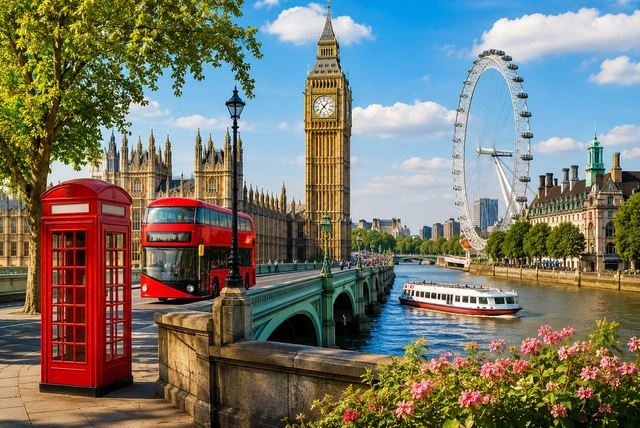
London rewards you the moment you step outside. Red buses roll past centuries-old buildings, Big Ben chimes somewhere in the distance, and a five-minute walk can take you from a royal palace to a street market to a rooftop bar. No two visits feel the same — one traveller comes for the museums and palaces, another falls for the canals and coffee shops tucked behind them.
This guide covers the landmarks everyone should see, the neighbourhoods most tourists skip, a sample one-day itinerary, and the practical details (transport, tickets, timing) that make a trip actually run smoothly.
In this guide
- Why London is worth the trip
- 25 must-see attractions
- Hidden gems most tourists miss
- Royal and historic London
- Family-friendly and free attractions
- Markets, food, and walking tours
- A sample one-day itinerary
- Shopping, fashion, and nightlife
- Practical travel tips
- FAQs
Why London Remains One of the World’s Greatest Cities
London is home to more than 170 museums, dozens of royal parks, and some of the world’s most famous theatres — and a huge share of it is free to visit. What sets the city apart is how easily old and new sit side by side: you can walk through a 1,000-year-old fortress in the morning and be looking out from a glass-walled rooftop bar by evening.
It’s also one of the most culturally diverse cities on earth, which shows up everywhere from the food markets to the museum collections. Whether you have two days or two weeks, London rarely runs out of things to show you.
25 Must-See Attractions and Iconic London Landmarks
These are the sights most first-time visitors build their trip around — and they’re popular for good reason. Royal & historic landmarks
- Big Ben & the Houses of Parliament
- Westminster Abbey
- Buckingham Palace (catch the Changing of the Guard)
- Tower of London
- Tower Bridge
- St Paul’s Cathedral
- Kensington Palace
Museums & galleries
- British Museum
- Natural History Museum
- Science Museum
- National Gallery
Parks & views
- St James’s Park
- Hyde Park
- London Eye
- Sky Garden
- Greenwich
Markets & neighbourhoods
- Covent Garden
- Borough Market
- Leadenhall Market
- Notting Hill
- Soho
- Shoreditch
- Little Venice
- Shakespeare’s Globe
Tip: several of these — the London Eye, Tower of London, and Sky Garden especially — sell out on weekends and school holidays. Book timed-entry tickets a few days ahead rather than turning up.
Hidden Gems in London That Most Tourists Miss
Once you’ve ticked off the landmarks, London’s quieter corners are where a trip starts to feel like your trip rather than a checklist.
- Neal’s Yard — a tiny, brightly painted courtyard tucked behind the crowds of Covent Garden.
- St Dunstan in the East — a bombed-out medieval church that’s now a quiet, ivy-covered public garden in the City.
- Little Venice — canal-side cafés and houseboats near Paddington, good for a slow morning walk.
- Kyoto Garden (Holland Park) — a Japanese-style garden with koi ponds and, often, peacocks wandering the paths.
- Shoreditch — street art, independent coffee shops, and a very different energy from central London.
None of these need a ticket or a booking — they’re best discovered by simply building in unstructured walking time between your main stops.
Walking Through Royal and Historic London
Few cities wear their history this visibly. Westminster Abbey has hosted coronations for centuries; Buckingham Palace is still the monarch’s working residence; the Tower of London, dating to 1066, guards the Crown Jewels and its resident ravens.
For the best free view of it all, walk out onto Westminster Bridge at dusk — Parliament lit up on one side, the London Eye turning slowly on the other, boats drifting along the Thames below.
Family-Friendly Attractions and Free Things to Do in London
London is an easier city to travel with kids in than its size suggests. The Natural History Museum’s dinosaur skeletons and the Science Museum’s hands-on exhibits are built for young visitors, and both sit a short walk from Hyde Park if anyone needs to burn off energy afterward.
Just as importantly, a large share of London’s best attractions cost nothing to enter:
- British Museum
- National Gallery
- Victoria and Albert Museum
- Natural History Museum & Science Museum (general admission)
- Watching street performers in Covent Garden
- Walking the South Bank
Special exhibitions inside these museums usually do charge, so check before you plan around one.
London Walking Tours, Food Markets, and Local Experiences
Ask a well-travelled Londoner what they remember most, and it’s rarely a single landmark — it’s the walk between them. A stroll along the South Bank from Westminster to Tower Bridge passes Shakespeare’s Globe, Borough Market, and half a dozen viewpoints most people never plan for, all without setting foot on the Tube.
Borough Market is the obvious food stop — stalls selling everything from fresh oysters to artisan cheese — but London’s food scene runs well beyond it, with strong food-truck and street-food scenes in areas like Shoreditch and King’s Cross.
A Sample One-Day London Itinerary
If you only have one day, this route keeps travel time short and covers the essentials:
- Morning — Westminster Abbey, Big Ben, and the Houses of Parliament
- Late morning — Buckingham Palace (aim to arrive before the Changing of the Guard, typically late morning — check the official schedule, as it varies by day)
- Lunch — Borough Market
- Afternoon — Tower of London, then walk across Tower Bridge
- Evening — London Eye at sunset, or Sky Garden for a free rooftop view (book ahead)
This route runs roughly east along the Thames, so you’re rarely backtracking.
Modern London: Shopping, Fashion, and Nightlife
London isn’t only a history lesson. Soho comes alive after dark with restaurants, theatres, and bars, while the city’s shopping runs from flagship luxury stores to small independent boutiques that set trends well beyond the UK. Every neighbourhood has its own character — Shoreditch’s creative, slightly rougher edge is a world away from the polish of Mayfair.
Travel Tips for First-Time Visitors to London
- Wear comfortable shoes. Many of the best moments in London happen between attractions, on foot.
- Book ahead for the London Eye, Tower of London, and Sky Garden, especially on weekends.
- Use contactless payment (card or phone) on the Tube and buses — it’s simpler than buying paper tickets and automatically caps your daily fare.
- Start early. Major attractions get noticeably busier from mid-morning onward.
- Stay central if you can. It cuts down commute time and gives you more flexibility to explore in the evening.
- Check the weather before you go — conditions can shift quickly, and it affects how you’ll want to split indoor versus outdoor time.
FAQs
What are the best places to visit in London for first-time visitors?
Buckingham Palace, Big Ben, Tower Bridge, Westminster Abbey, and the London Eye cover the essentials and give a strong first impression of the city’s history and skyline.
How much time do I need for a London sightseeing trip?
Three to five days lets you see the major landmarks without rushing. A well-planned one-day itinerary can still cover a surprising amount if you stay in one part of the city.
Is London expensive for tourists?
It can be, but many of the best things to do — major museums, parks, and walking routes along the Thames — are free.
Why does London attract so many visitors every year?
A combination of royal history, cultural diversity, world-class museums and theatre, and instantly recognisable landmarks.
What’s the best way to get around London?
The Underground, buses, and walking. Contactless card or phone payment is the easiest way to pay across all public transport.
What hidden gems are worth adding to a London itinerary?
Little Venice, Neal’s Yard, St Dunstan in the East, Kyoto Garden, and Shoreditch all offer a quieter, more local side of the city.