
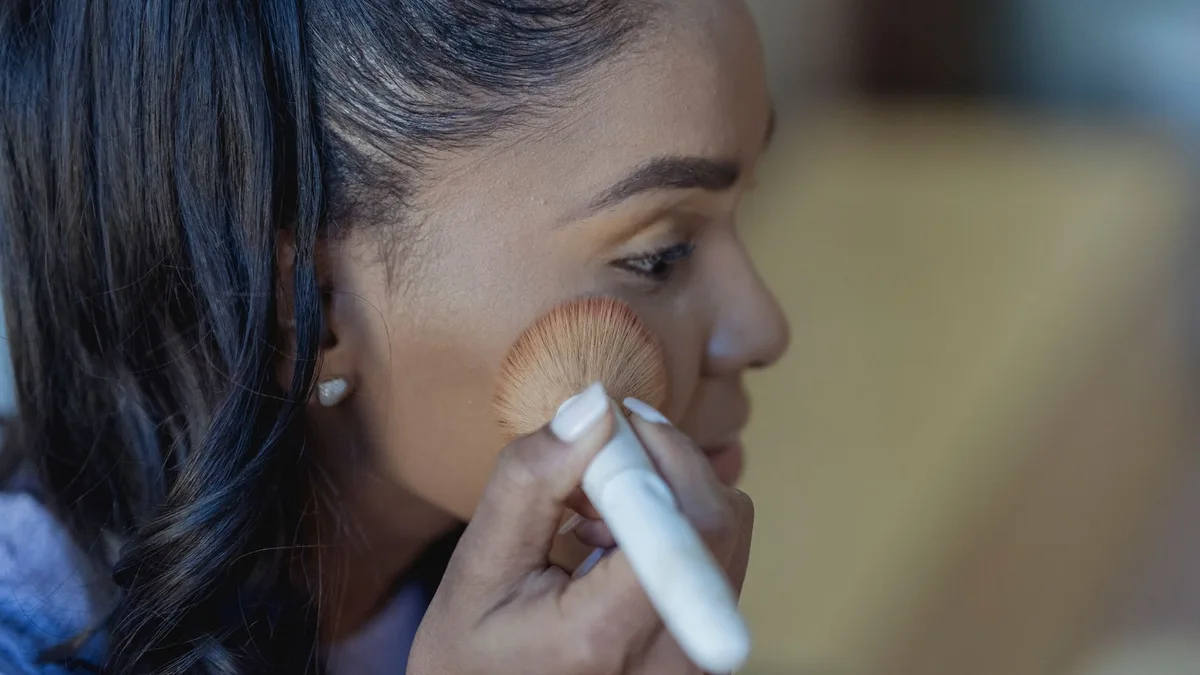
Somewhere along the way, “contour” and “bronzer” became interchangeable words for the same brown powder — and a lot of muddy, streaky faces were born as a result. They are not the same thing at all. One uses shadow to sculpt and define; the other uses warmth to make you look sun-kissed and alive. Use the wrong product in the wrong place and you get that heavy, dirty look; understand the difference and you can genuinely reshape and warm your face in minutes. Clearing up contouring versus bronzer is a rewarding step in our base makeup routine.
The Fundamental Difference
The distinction is all about colour and purpose. Contour is about shadow: it uses a cool-toned, greyish-brown shade to mimic the natural shadows of the face, creating the illusion of more sculpted cheekbones, a slimmer nose or a defined jaw. Bronzer is about warmth: it uses a warm, sometimes slightly shimmery brown to add the golden colour your skin gets from the sun, bringing life and glow. Contour reshapes; bronzer warms. Once you hold that difference in mind, you place each one completely differently.
Where Each One Goes
- Contour goes where shadows naturally fall: in the hollows under the cheekbones, along the sides of the nose, at the temples and under the jaw.
- Bronzer goes where the sun naturally hits: across the forehead, the tops of the cheeks, the bridge of the nose — the high points of the face.
Placing bronzer in the hollows or contour on the high points is exactly how faces end up looking muddy and confused.
Avoiding the Muddy Look
Muddiness comes from a few predictable errors, all easily fixed. Choosing a contour shade that is too warm or too orange reads as dirt rather than shadow — a true contour should be cool and subtle, like a real shadow. Using too much product, or too dark a shade for your skin, is the next culprit. And under-blending leaves harsh stripes. The rule is to build slowly with a light hand and blend, blend, blend, until there are no hard edges. You can always add more; you cannot easily take it away.
Do You Even Need Both?
Not necessarily. Plenty of people wear only bronzer for an everyday warm glow and skip contour entirely, reserving sculpting for special occasions or photos. Others love the definition of a contour. There is no rule that you must use both — choose based on the look you want. For a natural daytime face, a soft wash of bronzer and a touch of blush often does more than a full sculpting routine, which can look heavy in daylight.
Fitting It Into the Base
Apply contour and bronzer after foundation and concealer, once your base is even, so you are sculpting a finished canvas. Cream formulas blend beautifully into a dewy base, while powders work best over a set base. Finish with your setting step to lock it all in, choosing between setting spray and setting powder depending on the finish you want.
The Takeaway
Contour sculpts with cool shadow; bronzer warms with golden light — and knowing which goes where is the whole game. Place shadow in the hollows, warmth on the high points, choose the right undertones, and blend until seamless. Use one, the other, or both, but never confuse them, and your face looks defined and sun-kissed rather than muddy and overdone.