
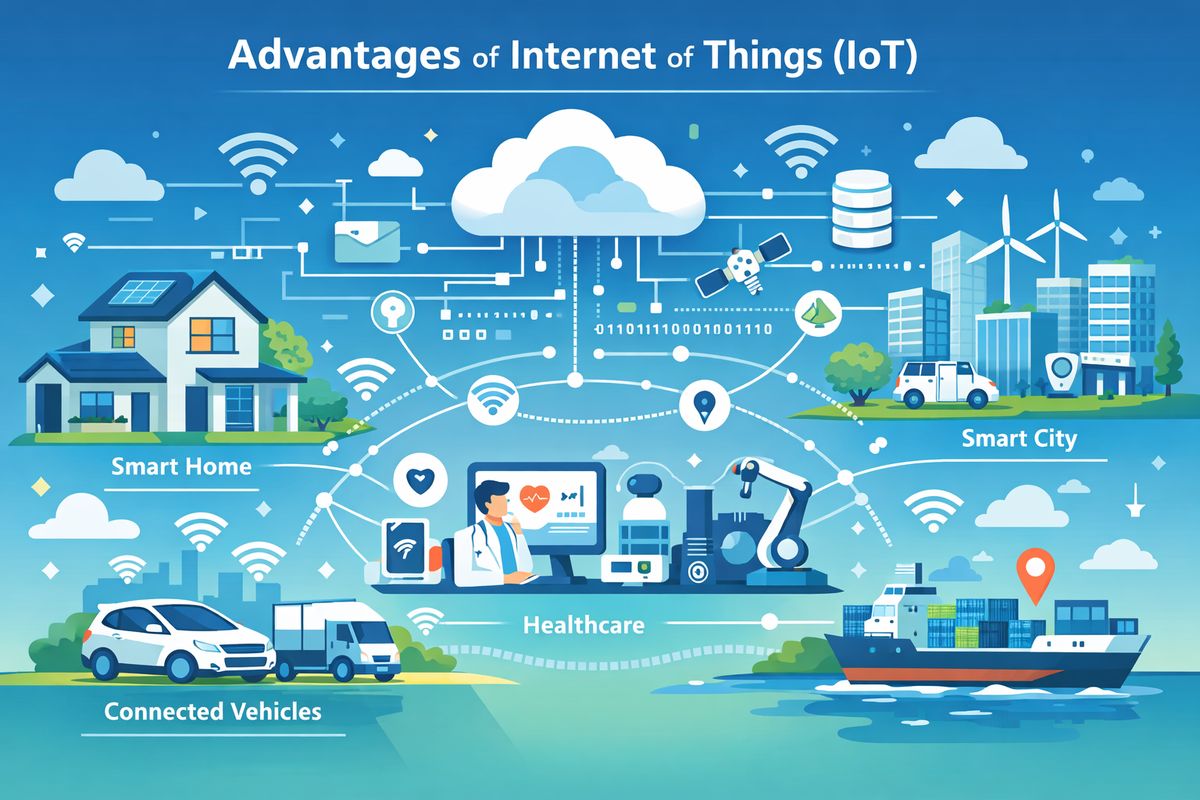
The main advantages of the Internet of Things (IoT) are automation, real-time monitoring, better decisions, lower running costs, improved safety, energy savings and more convenient products and services. By connecting everyday objects to sensors, software and the internet, IoT lets homes, businesses and cities respond to real conditions instead of guesswork. According to IoT Analytics, there were 21.1 billion connected IoT devices at the end of 2025, and the number is forecast to reach 39 billion by 2030. This guide explains the Internet of Things (IoT) in plain English, lists 12 key benefits with examples, shows how each industry gains, and covers the risks you should know about.
What Is the Internet of Things (IoT)?
The Internet of Things (IoT) is a network of physical objects fitted with sensors, software and connectivity. These objects collect data, share it, and often act on it with little human input.
A laptop or phone is used by a person. An IoT device mostly works on its own. A smart thermostat, a fitness tracker, a factory vibration sensor and a refrigerated lorry tracker are all examples.
How Does IoT Work?
Every IoT system follows the same five steps, shown below.
The Main Parts of an IoT System
- Sensors and devices: measure things such as heat, motion, location, vibration or heart rate. Actuators carry out actions, such as switching a valve.
- Connectivity: moves the data using Wi-Fi, Bluetooth, cellular networks (including 5G and NB-IoT) or LoRaWAN.
- Data processing: happens in the cloud or at the “edge”, which simply means close to the device. Edge processing is faster because data does not travel far.
- Apps and dashboards: show the results to people or trigger automatic actions.
Many systems store and analyse data in the cloud, so reliable cloud migration services are often part of an IoT project.
12 Key Advantages of the Internet of Things
The 12 benefits below fall into six groups: efficiency and cost, automation, data and decisions, safety, customer and wellbeing, and sustainability and growth.
1. Improved Operational Efficiency and Productivity
IoT replaces manual checks and paperwork with a continuous flow of data. Staff spend less time inspecting equipment and more time fixing real problems. Fraunhofer IML describes IoT integration as a way to cut manual workflows, avoid errors and improve processes in industry and warehousing. Condition: it only works if systems are properly connected and staff are trained to use the data.
2. Real-Time Monitoring and Visibility
Connected sensors show what is happening right now across machines, vehicles, stock and buildings. A fitness tracker showing your heart rate and a dashboard showing every lorry in a fleet work on the same idea. Visibility is only useful when the data is accurate and someone acts on it.
3. Better and Faster Decision-Making
IoT gives decision-makers current evidence instead of last month’s report. In Viasat’s 2024 survey of 600 industrial IoT decision-makers and implementers, 93% reported better decision-making as a benefit. This is a perception survey, not a performance audit. Poor-quality data can still lead to poor decisions.
4. Automation of Routine Tasks
When a sensor detects a set condition, IoT can trigger an action automatically. Lights switch on at dusk, heating turns off when a room is empty, and a warehouse conveyor adjusts to demand. Automation reduces repetitive work, but people still need to oversee it, because badly set rules can cause false alerts.
5. Predictive Maintenance and Less Downtime
Predictive maintenance means fixing equipment before it fails. Sensors track vibration, heat and pressure, and software flags unusual patterns. Fraunhofer says this can raise plant availability and cut maintenance costs. McKinsey-linked research is often cited for maintenance cost cuts of 18–25% and up to 50% less unplanned downtime, but results vary by site, so treat these as potential gains, not guarantees. You need good sensor coverage and past failure data.
6. Cost Savings and Better Resource Management
IoT shows where money is being lost, whether through wasted energy, emergency repairs, spoiled stock or excess inventory. In Verizon’s 2025 survey of 500 companies, 59% of manufacturing and warehousing respondents named cost savings as the main reason for deploying IoT. Savings are not automatic. Hardware, connectivity, installation and security all add cost, especially for small projects.
7. Energy Efficiency and Sustainability
Smart meters, building sensors and connected controls cut waste by adjusting heating, cooling and lighting to real use. At home, energy-efficient home appliances with smart controls can help you see and reduce your usage. In larger buildings, the same idea scales up to whole-site energy management. The size of the saving depends on correct installation and how people use the system.
8. Better Safety and Risk Reduction
IoT detects danger early. Gas, smoke and temperature sensors raise alerts in seconds, and equipment sensors can stop a machine before it causes harm. Microsoft cites real-time monitoring for hazards such as gas leaks and unauthorised equipment use. Alerts must be tested regularly, because too many false alarms make people ignore them.
9. Remote Monitoring and Control
You can check and control connected devices from anywhere through an app. Examples include locking a door from work, viewing a security camera, or monitoring a remote pump without a site visit. This saves travel time and cost. Remote access also raises the importance of strong passwords and regular updates.
10. Improved Customer Experience and Personalisation
Connected products tell businesses how they are really used. A connected car can remind its owner about a service, and a retailer can see which products run low. Many shops now use connected tills and stock systems alongside the cheapest card payment machines in the UK to keep service fast. Personalisation must respect privacy and consent rules.
11. Better Healthcare and Independent Living
Wearables and home sensors let people and care teams track health data outside a clinic. Remote patient monitoring can reduce unnecessary hospital visits for long-term conditions. Smartwatches and connected monitors also help older people stay independent for longer. These devices support care and do not replace professional advice. To see the kind of professionals who handle heart-monitoring data, read about what an EKG tech does, and for recovery after an operation, see surgical recovery technology.
12. New Revenue Streams and Product Innovation
Connected products send back usage data. Makers use it to improve designs and to offer subscriptions, remote support and pay-per-use services. A printer that reorders its own ink is a simple example. These models only work when customers see clear value and the data is handled securely. Even fashion and sport are joining in, as shown by AI shoes that gather movement data.
Read Also: Apple TV Outage: Is Apple TV Down Today? Latest Status, Causes, and Fixes
Advantages of IoT by Industry
The same technology brings different benefits in each sector. The table sums them up, with the usual obstacle for each.
| Industry | Main advantages | Typical use | Common barrier |
|---|---|---|---|
| Smart homes | Convenience, security, energy savings | Smart thermostats, lights, locks, cameras | Privacy and device compatibility |
| Healthcare | Remote monitoring, real-time health data | Wearables, connected medical devices | Data privacy and clinical validation |
| Manufacturing (IIoT) | Predictive maintenance, quality control, safety | Machine sensors, automated production lines | Legacy equipment, skills, cybersecurity |
| Agriculture | Precise water and input use, crop monitoring | Soil moisture sensors, smart irrigation | Rural connectivity and cost |
| Logistics | Live tracking, cold-chain monitoring, less spoilage and theft | Container and vehicle trackers | Network coverage and battery life |
| Retail | Inventory visibility, personalised service | Smart shelves, stock sensors | Privacy and system integration |
| Energy and utilities | Smart grids, demand management, early fault detection | Smart meters, grid sensors | Cybersecurity and ageing infrastructure |
| Smart cities | Traffic, waste and lighting management | Smart bins, street sensors | Funding and interoperability |
| Education | Campus safety, energy control, asset tracking | Smart classrooms, building controls | Budget and staff training |
| Small business | Lower costs, automated security, stock alerts | Smart thermostats, alarms, inventory sensors | Upfront cost and limited IT skills |
In farming, ITIF notes that soil-moisture sensors can cut water use while raising harvests, although results depend on crop, climate and connectivity. In shipping, sensors in containers help reduce spoilage and theft. In large buildings and offices, facility management software pulls sensor data into one view for heating, security and maintenance.
IoT Statistics and Market Growth in 2026
IoT is growing fast. The chart shows IoT Analytics’ device counts and forecasts.
Different organisations count devices in different ways. GSMA, for example, forecasts 26.1 billion total IoT connections in 2025, because it uses a broader definition than IoT Analytics. Do not compare the two figures directly.
| Statistic | Figure | Type | Source |
|---|---|---|---|
| Connected IoT devices, end of 2025 | 21.1 billion | Measured estimate | IoT Analytics |
| Connected IoT devices, 2030 | 39 billion | Forecast | IoT Analytics |
| Enterprise IoT market, 2025 | $324 billion (up 13%) | Market estimate | IoT Analytics |
| Enterprise IoT growth, 2026 | 14% | Forecast | IoT Analytics |
| Firms expecting meaningful benefits within two years | 98% | Survey of 500 firms (expectation) | Verizon, 2025 |
| Potential economic value of IoT by 2030 | Up to $12.5 trillion | Forecast | McKinsey |
Short-range technologies still carry most devices. IoT Analytics reports that Wi-Fi, Bluetooth and cellular lead the way.
Disadvantages of IoT You Should Know
IoT brings real benefits, but it also brings real challenges. The survey results below show both sides.
- Security and privacy risks: every connected device is a possible way in for attackers. Weak or default passwords and missing updates are the usual causes.
- High upfront costs: devices, installation, connectivity and integration all cost money before savings appear.
- Connectivity problems: IoT depends on a stable network, which is harder in rural areas and large buildings.
- Compatibility issues: devices from different makers may not work together, although the Matter standard is improving this in smart homes.
- Data overload: sensors create huge volumes of data, which must be stored, cleaned and analysed to be useful.
- Skills and maintenance: businesses need trained staff, regular updates and battery replacements. Many devices depend on battery charging technology that keeps improving.
- Electronic waste: large networks of short-lived devices create disposal and recycling pressure.
How to Reduce IoT Risks
Know every device on your network.
Change default passwords on day one.
Encrypt stored and transmitted data.
Give people only the access they need.
Install firmware updates promptly.
Record events so problems can be traced.
These six points follow the core device security features recommended by NIST. Keep smart devices on a separate network from work computers and personal files where you can.
IoT Security Rules and Standards
Governments are now setting minimum security standards for connected products.
| Rule or standard | Where | What it does |
|---|---|---|
| Product Security and Telecommunications Infrastructure (PSTI) Act | UK | Bans universal default passwords and requires a vulnerability reporting contact and clear support periods for consumer devices |
| Cyber Resilience Act (CRA) | EU | In force since December 2024. Reporting duties began on 11 September 2026 and full requirements apply from 11 December 2027 |
| US Cyber Trust Mark | US | Voluntary security label for consumer IoT products |
| NIST IR 8259 and SP 800-213 | Global guidance | Security activities for makers and risk-based guidance for buyers |
| NCSC smart device guidance | UK | Practical advice on setting up and securing smart devices |
IoT, IIoT, AIoT and M2M: What Is the Difference?
| Term | Meaning | Example |
|---|---|---|
| IoT | Connected devices for homes, businesses and cities | Smart thermostat, fitness tracker |
| IIoT | Industrial IoT: rugged systems for factories, energy and heavy equipment | Vibration sensors on a production line |
| AIoT | IoT data combined with artificial intelligence for prediction and automatic decisions | Camera that spots a safety hazard |
| M2M | Machines talking directly to each other, an older and narrower idea | Vending machine reporting its stock |
What Is the Future of IoT?
IoT Analytics describes 2026 as the start of an “AI phase” for enterprise IoT, with AI helping drive the forecast 14% market growth. Expect more AI-driven predictions, more 5G-connected devices, smarter factories and stricter security rules. Cleaner power will matter too, as devices and data centres need energy, and developments such as perovskite solar panels could help power remote sensors.
Read Also: Prime Technology Ltd: Computers, Accessories & Reliable Tech Support
Conclusion
The advantages of the Internet of Things are clear: less manual work, live visibility, better decisions, lower waste, safer workplaces, smarter homes and new services. The gains are real but not automatic. They depend on good planning, reliable connections and strong security. Start with one clear problem, such as energy waste or machine breakdowns, measure the result, and then expand.
Frequently Asked Questions (FAQs)
What are the main advantages of IoT?
Automation, real-time monitoring, better decision-making, cost and energy savings, improved safety, remote control and better customer experiences. Businesses also gain predictive maintenance and new services.
What are the disadvantages of IoT?
Security and privacy risks, high upfront costs, connectivity problems, compatibility issues, data overload, skills gaps and electronic waste.
How does IoT help businesses?
It shows what is happening in real time, automates routine tasks, warns of equipment faults early and cuts waste. Results depend on setup quality and staff skills.
What are examples of IoT devices?
Smart thermostats, video doorbells, fitness trackers, connected cars, smart meters, factory sensors, soil moisture sensors and shipment trackers.
How is IoT used in healthcare?
Wearables and connected monitors send health data to patients and care teams, supporting remote patient monitoring and earlier action. They support, but do not replace, professional care.
What is the difference between IoT and IIoT?
IoT covers all connected devices. IIoT is IoT used in industry, where reliability, uptime and safety matter most.
Is IoT safe?
It can be, if devices have unique passwords, receive updates and sit on a secure network. Weak security is the main danger, which is why laws such as the UK PSTI Act now set minimum standards.
How many IoT devices are there?
IoT Analytics counted 21.1 billion at the end of 2025 and forecasts 39 billion by 2030. GSMA uses a wider definition and forecasts 26.1 billion connections in 2025.
What is the future of IoT?
IoT will increasingly combine with AI and 5G for smarter automation, while security rules tighten and device numbers keep growing.