
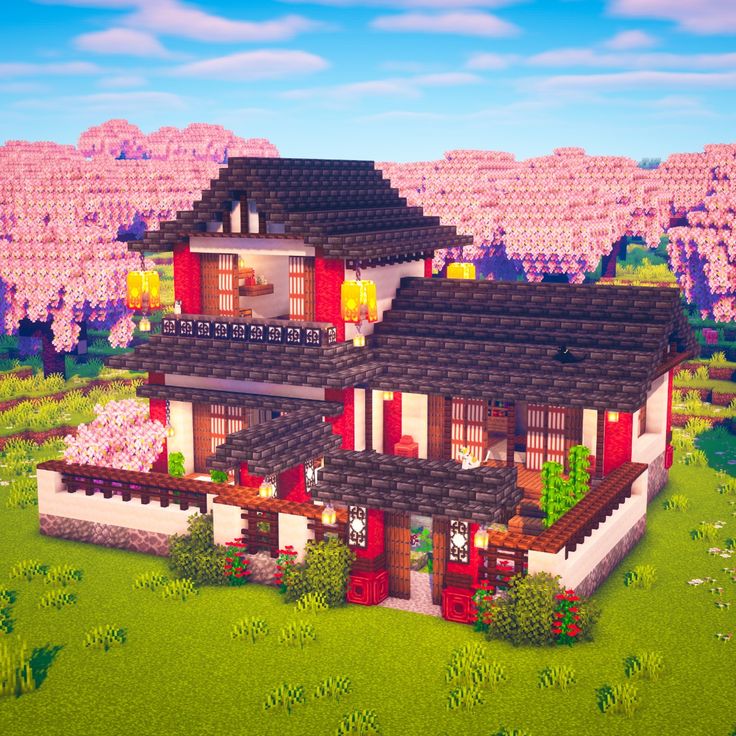
To build a Japanese house in Minecraft, use a spruce or dark oak frame, light-coloured walls, a raised floor, a layered roof with wide overhanging eaves, and a small garden. If you are new to the style, start with a compact 7 × 9 starter house. It uses cheap, early-game blocks, and you can add a pond, veranda or second roof layer later.
This guide gives you 12 Japanese Minecraft house ideas, the best block palettes, a step-by-step build, survival tips, interior and garden ideas, and advice on schematics. Shrines, temples, pagodas and castles are covered in a separate section because they are not homes. If you want wider inspiration first, browse our Minecraft build ideas and come back when you are ready for something calmer.
What Is a Japanese Minecraft House?
A Japanese Minecraft house copies the look of traditional Japanese homes using simple, natural-looking blocks. The style is about balance and calm rather than size. Most designs share the same few features:
- A dark timber frame with light walls between the beams
- A layered roof with deep eaves, never a flat box
- A floor raised slightly above the ground
- A wooden veranda, called an engawa, under the roof edge
- Sliding screens (shoji) and a garden with lanterns, bamboo or water
Two real-world house types appear most often in Minecraft builds. A minka is a traditional farmhouse, and a machiya is a narrow townhouse. According to Nippon.com, traditional homes raise the main floor above the ground to reduce damp, and they use sliding screens that let light through. Minecraft has no tatami or paper, so we use stairs, slabs, trapdoors and glass panes to suggest the same details.
Modern Japanese houses keep the calm feel but use cleaner lines, large windows and lighter materials such as quartz and concrete. The 12 ideas below cover both.
12 Best Japanese Minecraft House Ideas
Dimensions below are suggested starting sizes, not fixed rules. Block counts depend on your roof and layout, so treat any totals as estimates. Use the table to pick a build, then read the short notes under it.
| # | House idea | Difficulty | Suggested footprint | Key blocks | Best for |
|---|---|---|---|---|---|
| 1 | Small starter house | Beginner | 7 × 9 | Spruce, stone bricks, glass panes | First survival base |
| 2 | Minka farmhouse | Intermediate | 11 × 13 | Spruce logs, cobblestone, dark oak stairs | Rural villages |
| 3 | Cherry blossom house | Beginner to intermediate | 9 × 11 | Cherry planks, cherry leaves, lanterns | Cherry Grove bases |
| 4 | Machiya townhouse | Intermediate | 9 × 15 | Dark oak, spruce, trapdoors | Town streets |
| 5 | Tea house | Beginner | 9 × 9 | Bamboo, stripped logs, stone slabs | Decorative builds |
| 6 | Modern Japanese house | Intermediate | 15 × 15 | Smooth quartz, dark oak, glass | Modern cities |
| 7 | Bamboo house | Beginner to intermediate | 9 × 11 | Bamboo planks, bamboo mosaic, fences | Jungle and green areas |
| 8 | Stilt house | Intermediate | 9 × 11 | Spruce logs, planks, stairs | Rivers and coasts |
| 9 | Large mansion | Advanced | 15 × 20 | Dark oak, deepslate, white concrete | Creative worlds |
| 10 | House with garden and pond | Intermediate | 13 × 15 including garden | Stone, water, lanterns, bamboo | Showcase builds |
| 11 | Survival-friendly interior house | Intermediate | 9 × 11 | Spruce, furnaces, chests, beds | Daily survival use |
| 12 | Samurai-style house | Advanced | 17 × 17 | Dark roofs, red accents, walls | Roleplay |
1. Small Japanese Starter House
This is the best first build. Use a 7 × 9 base of spruce planks, logs at the corners and glass panes for windows. Finish with a gently sloped stair roof that sticks out past the walls. It takes little time and uses blocks you can gather on day one.
2. Traditional Japanese Minka Farmhouse
A minka has exposed wooden pillars, a raised wooden floor and a steep, deep roof. Use spruce logs for the frame, cobblestone for the foundation and dark stairs for the roof. A steep roof is the feature that makes it look like a farmhouse rather than a cottage.
3. Japanese Cherry Blossom House
Cherry wood and cherry leaves give a pink and white look. Pair cherry planks with white walls and lanterns for contrast, then add stone paths and a small pond. Cherry blocks arrived in Minecraft 1.20, so older tutorials may not include them. Build it in or near a Cherry Grove for the best result.
4. Japanese Machiya Townhouse
A machiya is narrow and deep. Build a 9 × 15 plan with a timber front, compact rooms and a small courtyard at the back. Repeat the design along a street to make a believable town in a multiplayer world.
5. Japanese Tea House
Keep this small and open. Use bamboo or stripped logs, trapdoors for screens and stone slabs for a base, then place it beside a pond. It works well as a decorative building next to a bigger home.
6. Modern Japanese House
Use smooth quartz or concrete walls, dark oak trim and large glass windows. The roof can be flat or gently layered with slabs. This style costs more than a wooden house because quartz and glass take longer to gather in survival.
7. Bamboo Japanese House
Bamboo planks, bamboo mosaic, fences and trapdoors suit jungle and bamboo forest areas. Note that, according to the Minecraft Wiki, a block of bamboo gives two planks, while a normal log gives four. Plan to gather more bamboo than you would wood.
8. Japanese Stilt House
Raise the house on log pillars over water or a slope. Add a wooden walkway or stairs to the door and light the platform so mobs cannot spawn on it. It suits riverbanks and coastlines.
9. Large Japanese Mansion
A mansion adds several rooms, a courtyard, a balcony and a storage room under a more detailed roof. It needs far more materials, so it is best for advanced survival players or creative mode.
10. Japanese House With a Garden and Pond
Connect the veranda to a garden using stone paths, water, lanterns, bamboo and a small bridge. This is the most scenic option and works as a showcase build.
11. Japanese House With a Survival-Friendly Interior
Plan the rooms around what you actually use: bed, crafting table, furnaces, chests and food storage. Keep rooms compact to save resources, and light every corner and entrance.
12. Fantasy or Samurai-Style Japanese House
Use dramatic layered roofs, red accents, wooden gates and a walled courtyard. This is inspired by Japanese architecture rather than a historically accurate design, so it suits roleplay and creative worlds best.
Which Japanese House Should You Build?
The chart below compares six popular styles on how easy they are to live in during survival mode. Scores run from 1 (poor) to 5 (excellent) and are editorial estimates based on size, materials and layout, not measured block counts.
Size is the main reason. The next chart shows the floor area of the suggested footprints in this guide. A 15 × 15 house covers more than three times the ground of a 7 × 9 starter, and the roof, walls and interior grow with it.
Best Block Palettes for Japanese Minecraft Houses
Keep your palette small. Most good Japanese builds use one wood for the frame, one light wall block, one dark roof block and one stone for the base. According to Minecraft-Schematics, consistent materials give a more polished look. Cherry and bamboo wood sets need Minecraft 1.20 or later, and the Wiki lists them for both Java and Bedrock.
| Part of house | Traditional | Cherry blossom | Bamboo | Modern |
|---|---|---|---|---|
| Frame | Stripped spruce or dark oak logs | Stripped cherry logs | Block of bamboo | Dark oak or mangrove |
| Walls | White concrete, wool or terracotta | White concrete | Bamboo mosaic | Smooth quartz, concrete |
| Roof | Spruce or dark oak stairs and slabs | Cherry stairs and slabs | Bamboo stairs and slabs | Stone or concrete slabs |
| Foundation | Cobblestone, stone bricks | Stone bricks | Stone slabs | Polished stone |
| Windows and screens | Glass panes, trapdoors | Glass panes, cherry trapdoors | Bamboo trapdoors, fences | Large glass panes |
| Lighting | Lanterns | Lanterns | Lanterns | Hidden lights, lanterns |
A simple guide for how much of each material group a typical traditional house needs is shown below. It is a rule of thumb for planning, not a measured figure.
How to Build a Japanese House in Minecraft, Step by Step
These steps work for most of the 12 ideas. Plan the footprint on a grid first. If you like sketching layouts on paper, our Minecraft colouring pages are a fun way to get younger builders involved.
Step 1: Choose a Location
Pick a flat area, a gentle hillside, a riverbank or a Cherry Grove. Clear the land and mark the corners of your footprint with torches or blocks.
Step 2: Build the Foundation
Lay a stone or wood base and raise it one block above the ground. Mark the door and the room layout before you build upwards.
Step 3: Create the Wooden Frame
Place logs at each corner and along the walls, then join the pillars with horizontal beams. Keep the spacing even, for example one pillar every three or four blocks.
Step 4: Add Walls and Windows
Fill the gaps between the beams with a light block. For shoji-style windows, combine glass panes with trapdoors or fences to make a grid. Leave openings for doors and fresh air.
Step 5: Build the Roof
The roof is the most important part. Start with a simple gable or hip roof using stairs, then let the edges stick out at least one block beyond the walls. Add slabs at the tips so the edge looks lifted, and place a second, smaller roof layer above or below for depth. A flat or tight roof is what makes most Japanese builds look like boxes.
Step 6: Add Doors and a Veranda
Build wooden steps to the entrance and add an engawa-style veranda under the eaves. Fences and trapdoors make good railings and screens.
Step 7: Finish the Interior and Garden
Add storage, a bed and lighting, then lay a stone path and finish with lanterns, bamboo or a cherry tree. Step back and check the house from several angles before you stop.
Japanese Minecraft House Ideas for Survival Mode
In survival, size is your biggest cost. A 7 × 9 starter is quick to finish, while a mansion can take days of gathering. Start small, then extend the house as you collect more wood and stone.
Starter materials checklist. For a small house you will need:
- Spruce planks, logs and stairs for floor, frame and roof
- Cobblestone or stone bricks for the foundation
- Glass panes and trapdoors for windows
- Lanterns, a bed, a crafting table, a furnace and chests
Exact quantities depend on your roof size, so count your blocks once you have drawn the plan. To make the house work as a base, add a bed, furnaces and chests, plus a small crop plot nearby. Light the inside, the veranda and the paths so hostile mobs cannot spawn close to the door. Once you are settled, you can set up a beacon in Minecraft in the garden for useful bonuses.
Japanese Minecraft House Interior Ideas
- Tatami-style floors: use carpets or two contrasting blocks in a rectangular pattern.
- Shoji and fusuma doors: use glass panes with trapdoors for light screens, and solid wood or wool for room dividers.
- Bedroom and living room: keep furniture low and the room uncluttered.
- Kitchen and storage: compact counters, barrels, chests and furnaces along one wall.
- Lighting: lanterns on beams or hidden light sources under slabs to avoid dark corners.
Japanese Minecraft Garden and Landscaping Ideas
A garden turns a good house into a great build. Use the ideas below and keep them simple.
- Cherry trees: build a rounded canopy with cherry leaves and a slightly bent trunk.
- Bamboo garden: plant bamboo along a narrow stone path with fences as screens.
- Pond and bridge: dig a small pond and cross it with a short wooden bridge.
- Stone lanterns: stack a wall, slab and lantern for a quick garden lantern.
- Courtyard: enclose a small space with a waterfall or a single tree as the focus.
Japanese Minecraft Buildings Beyond Houses
Shrines, temples, pagodas and castles are not homes, but they pair well with houses in a village. Treat them as extra projects.
| Structure | Main features | Difficulty |
|---|---|---|
| Shrine and torii gate | Red gate, stone lanterns, small hall | Intermediate |
| Temple | Symmetrical layout, wooden pillars, layered roofs | Advanced |
| Five-tiered pagoda | Each floor smaller than the one below, repeated roofs | Advanced |
| Castle | Large stone base, white walls, towers | Advanced |
| Village and ramen shop | Homes, shops, paths and shared gardens | Beginner to intermediate |
For the pagoda, build a square stone base, add wooden pillars, then repeat the roof on each level with the floor getting slightly smaller. For more on temple roofs, BuildPaste is a useful place to compare layouts.
Java and Bedrock Differences
You can build almost every design above by hand in both editions, because the wood, stone and glass blocks are the same. Cherry and bamboo blocks need version 1.20 or later. Minecraft now uses year-based version numbers, so check that your game is up to date.
The difference is mainly with downloads. A schematic made for Java may not import straight into Bedrock, so check the creator’s page before you download anything.
Blueprints, Schematics and Downloads
If you would rather copy than design, look at original creator projects on Planet Minecraft. Some listings give a house-only schematic, and others give a full map with gardens. Read the project page before you download and check:
- The Minecraft version and edition it was made for
- Whether it needs a mod or a schematic tool
- The creator’s licence and credit rules
- Whether it is a schematic or a complete world
- That the download comes from the creator’s own page, not a mirror
Some older projects target version 1.16.2 or 1.19, so test them before building on a current world. Always credit the original builder.
Tools, Texture Packs and Shaders
You do not need mods to build any of these houses. Schematic tools such as Litematica (Java) help if you want to paste a design, and texture packs or shaders are optional. Texture packs improve wood and roof detail, while shaders improve lighting and water. Check each pack’s official page for the version it supports before installing.
Common Mistakes to Avoid
- Building a flat or narrow roof with no overhang
- Mixing too many unrelated colours
- Leaving out wooden beams and support pillars
- Filling a small house with too many decorations
- Skipping lighting and storage in a survival base
- Downloading schematics without checking the version
FAQs About Japanese Minecraft Houses
Q. How do you build a Japanese house in Minecraft?
Build a raised foundation, add a log frame, fill the walls with light blocks, then finish with a layered roof with wide eaves and a small garden.
Q. What blocks are best for Japanese Minecraft houses?
Spruce and dark oak for the frame, white concrete or terracotta for walls, stairs and slabs for roofs, stone for the base, and lanterns for light. Cherry and bamboo work well for accents.
Q. How do you build a traditional Japanese roof in Minecraft?
Use stairs for the slope and slabs at the edges. Extend the eaves past the walls and add a second roof layer for depth.
Q. What is the best wood for a Japanese Minecraft house?
Spruce and dark oak give a classic dark look. Cherry gives a pink, soft finish, and bamboo gives a light, natural finish.
Q. What are traditional Japanese houses called?
Farmhouses are called minka and townhouses are called machiya.
Q. How do you make a Japanese sliding door in Minecraft?
Make a grid from glass panes, trapdoors or fences inside a wooden frame. Use a solid block for opaque dividers.
Q. What size should a small Japanese Minecraft house be?
A 7 × 9 footprint is a good starting point, though the right size depends on your design.
Q. Can you build Japanese houses in Survival mode?
Yes. Choose a small footprint, simplify the roof and use materials you can gather easily.
Q. Are Japanese Minecraft houses available for Bedrock Edition?
You can build them by hand in Bedrock. Downloads and schematics may need a compatibility check.
Q. Where can I download Japanese Minecraft house schematics?
Use the creator’s own page on Planet Minecraft or another trusted source, and check the version and licence first. You can also browse BuildItApp for small-house ideas.
Final Thoughts
Start with a small traditional house, get the roof right, then add a garden and a second roof layer as your skills grow. After that, try a cherry blossom home, a modern villa or a whole village. For more gaming guides, visit our gaming section, or read our earlier guide to Japanese Minecraft houses for extra layouts and inspiration.
Author Bio
The editorial team at thelondonreport creates helpful and easy-to-read content for readers across the UK. They focus on gaming, technology, and lifestyle topics, making complex ideas simple and enjoyable.
Disclaimer
This article may be updated by the editorial team at thelondonreport to improve accuracy and keep information current.